


What's Happening?
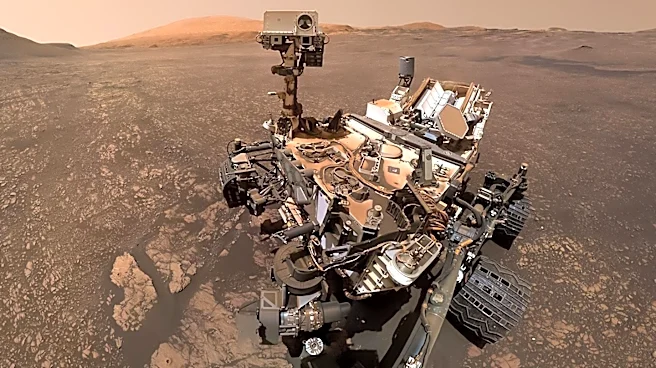
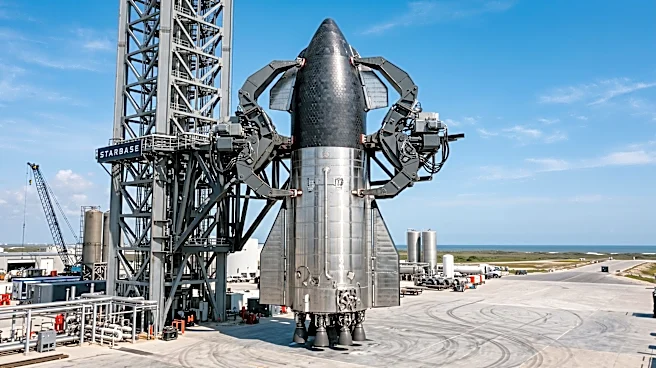
NASA's SkyFall mission, which involves a trio of Ingenuity-class helicopters designed to explore Mars, is slated for launch in late 2028 aboard the Space Reactor-1 Freedom (SR-1) rocket, the agency's first fission nuclear-powered interplanetary spacecraft.
The SR-1 will deploy the SkyFall entry capsule during a second Mars approach in late 2030. However, experts, including Scott Hubbard, former director of NASA's Ames Research Center and former Mars Program Director, are questioning the decision to combine these two high-profile missions. Hubbard describes the pairing as a 'shotgun marriage,' suggesting that SkyFall's approval may have been driven by programmatic or political reasons, with the helicopter mission piggybacking on the SR-1 as an initial step towards a 'nuclear NASA.' The SkyFall project has rapidly expanded, with over 200 individuals now working on the initiative, aiming to demonstrate helicopter exploration as a science platform.
Why It's Important?
The decision to launch NASA's SkyFall Mars helicopters on the nuclear-powered SR-1 Freedom rocket raises significant programmatic and strategic questions for the U.S. space agency. Combining a technology demonstration (SR-1) with a science mission (SkyFall) in an 'unusual set of management issues,' as noted by Scott Hubbard, could complicate mission objectives and timelines. While the SkyFall mission aims to fill a 'resolution gap' in Mars exploration by providing high-resolution imagery and subsurface data, its dependence on the SR-1's readiness introduces a potential single point of failure. The planetary science community is now tasked with developing scientific requirements and objectives that align with SkyFall's capabilities, a reversal of the usual sequence for science missions. This approach could set a precedent for future NASA missions, potentially influencing how technology demonstrations are integrated with scientific exploration, and whether programmatic considerations outweigh purely scientific ones.
What's Next?
For the SkyFall mission, the immediate next steps involve scientific community input through two workshops next year. These workshops will review SkyFall's scientific objectives and help determine potential landing sites on Mars, with final decisions to be made at NASA Headquarters. A critical factor for the mission's success is the on-time delivery of the Space Reactor-1 Freedom. While NASA considers the two endeavors as a pair, SkyFall Project Scientist Matthew Golombek stated that if SR-1 is not ready, SkyFall could be launched on a conventional vehicle like a Falcon 9. The SkyFall helicopters are designed for a six-month prime mission, with a one-year goal, arriving in Mars's northern spring to avoid dust storms. Their scientific tasks include capturing high-resolution imagery, probing subsurface structures, investigating geomorphology, and studying the Martian atmosphere and radiation environment.
Beyond the Headlines
The 'shotgun marriage' of the SkyFall mission and the SR-1 nuclear rocket could signify a broader strategic shift within NASA towards integrating advanced propulsion technologies with scientific exploration. While nuclear electric propulsion (NEP) may not significantly reduce transit time to Mars, its value lies in risk reduction for future missions to the Moon, outer planets, and potentially interstellar travel. This approach could accelerate the development and deployment of nuclear propulsion, but it also carries the risk of entangling scientific objectives with the inherent challenges and delays of pioneering new technologies. The debate over this mission's structure highlights the tension between demonstrating new capabilities and ensuring the focused pursuit of scientific knowledge, potentially influencing future funding and prioritization within NASA's diverse portfolio of space exploration endeavors.