

What's Happening?
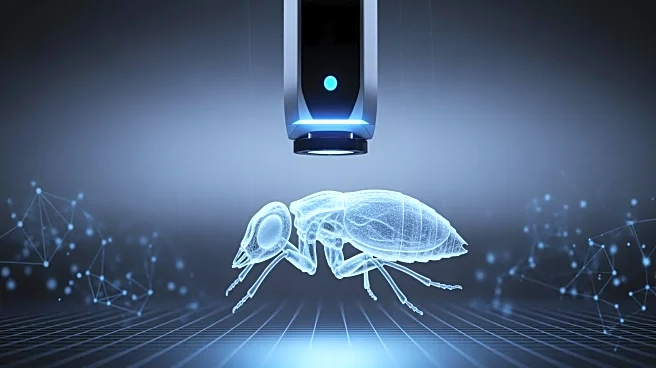
A team of international researchers has developed a new platform called Antscan, which uses advanced 3D scanning technology to create a detailed atlas of ant morphology. This project, described in Nature Methods, involves entomologists, accelerator physicists,
computer scientists, and biological imaging specialists. The Antscan platform provides micrometer-resolution reconstructions of ants, revealing intricate details of their exoskeletons, muscles, nerves, digestive tracts, and stingers. The data spans 792 species across 212 genera, covering a significant portion of ant diversity. These high-resolution images are now accessible through an online portal, allowing users to interact with the data by rotating, zooming, and virtually dissecting the insects. This initiative not only enhances scientific research but also democratizes access to natural history collections, enabling broader public engagement.
Why It's Important?
The Antscan project represents a significant advancement in the digitization of natural history collections, offering unprecedented access to detailed anatomical data. This development is crucial for various stakeholders, including scientists, educators, and the general public. By providing a comprehensive digital resource, Antscan facilitates comparative studies across ant species, potentially leading to new insights in evolutionary biology and ecology. Moreover, the platform's accessibility can inspire educational and creative applications, such as in video game design and art. The project's success also sets a precedent for similar digitization efforts in other biological fields, potentially transforming how biological diversity is studied and preserved.
What's Next?
The Antscan team envisions expanding the project's scope to include other insect species and small invertebrates, leveraging the same technology to create a broader digital library of biodiversity. This expansion could further enhance the study of morphology and support conservation efforts by providing a detailed record of species that may be at risk of extinction. Additionally, the integration of artificial intelligence tools could unlock new analytical capabilities, allowing researchers to explore complex biological patterns and relationships. As the project grows, securing access to synchrotron facilities and scaling computational infrastructure will be critical to its continued success.
Beyond the Headlines
The Antscan initiative highlights the potential for technology to revolutionize the preservation and study of biological specimens. By creating digital 'twins' of physical specimens, the project offers a solution to the challenges of maintaining and accessing fragile natural history collections. This approach not only preserves valuable scientific data but also ensures that it remains accessible for future generations. As biodiversity faces increasing threats from environmental changes, projects like Antscan provide a vital tool for documenting and understanding the natural world, offering a digital safeguard against the loss of biological knowledge.