
What's Happening?
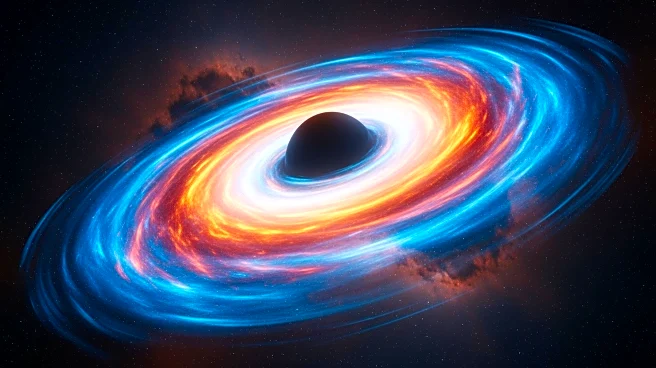
The XRISM (X-Ray Imaging and Spectroscopy Mission) has achieved a significant breakthrough in black hole research by capturing the sharpest X-ray spectrum of a spinning black hole in the galaxy MCG-6-30-15.
This galaxy, located 120.7 million light-years away, is home to a supermassive black hole estimated to be 2 million times the mass of the Sun. The mission, in collaboration with ESA's XMM-Newton and NASA's NuSTAR, isolated the warped X-ray signatures of iron near the black hole's event horizon, confirming relativistic effects predicted by Einstein's theory. The XRISM's high-resolution 'Resolve' instrument allowed scientists to distinguish between emissions from the inner disk and those from gas clouds further out, a feat previously unattainable. The study also identified five distinct zones of outflowing wind around the black hole, contributing to a better understanding of galaxy growth regulation.
Why It's Important?
This discovery is crucial for advancing the understanding of black hole dynamics and their interaction with host galaxies. By providing a clearer picture of the relativistic effects near a black hole's event horizon, the XRISM mission enhances the ability to study the spin and wind structures of supermassive black holes (SMBHs). These insights are vital for tracking how black holes feed and evolve, impacting theories on galaxy formation and evolution. The ability to separate X-ray sources with high precision opens new avenues for research, potentially leading to more accurate models of black hole behavior and their influence on cosmic environments. The findings also challenge existing models of distant reflection, suggesting the need for revised theories on the chemical composition and structure of the regions surrounding black holes.
What's Next?
Future research will focus on addressing the spectral variability observed during the XRISM mission's five-day campaign, which showed significant flux changes. Time-resolved analyses are planned to further explore these variations and refine the understanding of the black hole's emission dynamics. Additionally, the unexpected weakness of the distant reflection component will be investigated, with alternative models being tested to explain the observed spectral profiles. The data collected by XRISM, XMM-Newton, and NuSTAR will continue to serve as a foundation for ongoing studies, potentially leading to new discoveries in black hole astrophysics and the broader field of cosmology.
Beyond the Headlines
The XRISM mission's findings have broader implications for the study of cosmic phenomena and the fundamental laws of physics. By confirming relativistic effects with unprecedented precision, the research supports and extends Einstein's theory of general relativity. The detection of multiple wind layers around the black hole also highlights the complex interplay between SMBHs and their environments, which could influence future models of galaxy evolution. These insights may lead to a deeper understanding of the universe's structure and the forces shaping it, offering a glimpse into the intricate mechanisms governing cosmic systems.