







What's Happening?
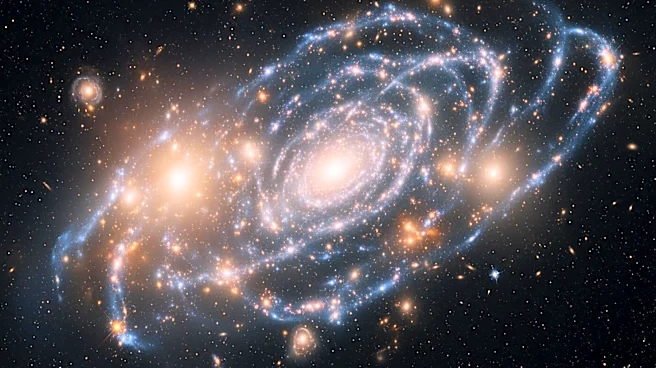
An international team of astronomers has successfully pinpointed the boundary of the Milky Way's star-forming disk, a longstanding question in Galactic archaeology. By examining the ages of stars, researchers determined that most star formation occurs
within about 40,000 light-years of the Galactic Center. This discovery was made by combining measurements of bright giant stars' ages with advanced galaxy evolution simulations, revealing a 'U-shaped' pattern in stellar age distribution. This pattern marks the outer limit of active star formation in the Milky Way. The study highlights the inside-out growth of galaxies, where star formation begins in dense central regions and spreads outward over billions of years. The findings also explain why stars exist beyond the star-forming edge, attributing it to radial migration, where stars gradually move outward from their birthplaces.
Why It's Important?
This discovery is significant for understanding the Milky Way's structure and evolution. By defining the star-forming boundary, astronomers can better comprehend the processes shaping our galaxy. The research provides a clearer picture of how the Milky Way has developed over billions of years, offering insights into the dynamics of star formation and migration. This knowledge is crucial for Galactic archaeology, as it helps decode the history of our galaxy. The study also demonstrates the power of combining observational data with simulations, paving the way for future discoveries in Galactic research. Understanding the Milky Way's structure can also inform studies of other galaxies, contributing to a broader understanding of the universe.
What's Next?
Future surveys, such as 4MOST and WEAVE, will provide more detailed observations, allowing astronomers to refine these measurements and better understand the factors shaping the Milky Way's structure. These surveys will enhance the precision of stellar age measurements, further unraveling the history of our galaxy. The research also opens new avenues for exploring the causes behind the sharp decline in star formation efficiency at the identified boundary. As technology advances, astronomers will continue to use simulations and observational data to explore the Milky Way's evolution, potentially uncovering new aspects of Galactic dynamics and star formation processes.