


What's Happening?
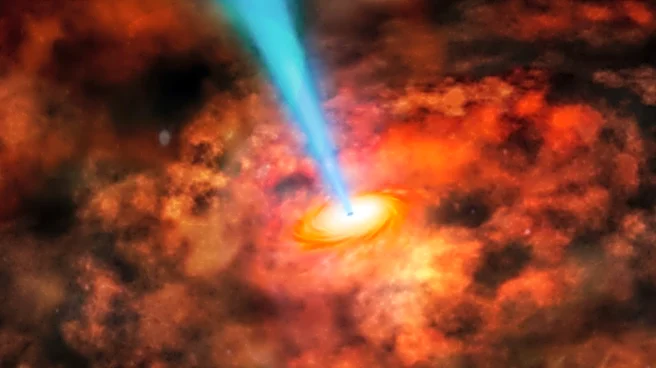
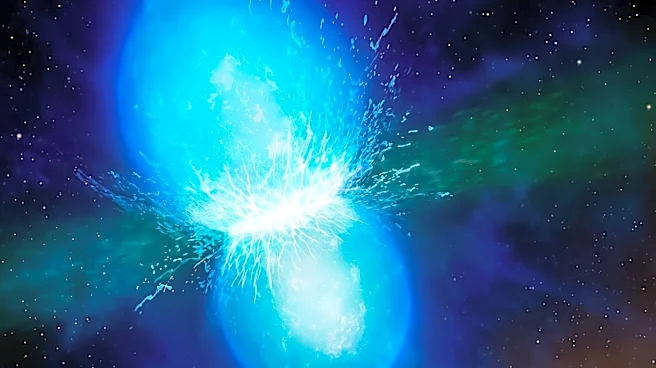
Black holes, formed from the gravitational collapse of massive stars, are theorized to potentially interact with a fifth dimension, though direct evidence for this remains absent. This theoretical suggestion expands on the understanding of these ultra-dense
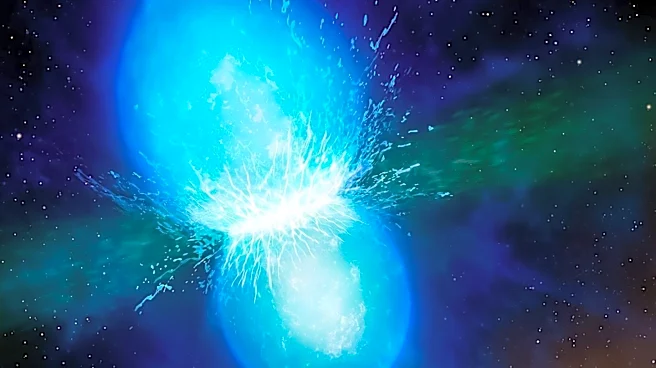
cosmic remnants. Furthermore, primordial black holes, which are hypothesized to have originated from overdense regions in the early universe, are being considered as a possible explanation for dark matter. Recent scientific investigations indicate that black holes, irrespective of their size, appear to adhere to similar physical principles when they eject jets into space. These findings contribute to the ongoing efforts to unravel the mysteries surrounding black holes and their fundamental properties within the universe.
Why It's Important?
The theoretical link between black holes and a fifth dimension, if ever substantiated, could fundamentally alter our understanding of spacetime and the universe's structure. This would have profound implications for theoretical physics, potentially leading to new models of cosmology and quantum gravity. The hypothesis that primordial black holes could constitute dark matter is equally significant. Dark matter, which makes up a substantial portion of the universe's mass, remains one of the most elusive components of cosmic understanding. If primordial black holes are indeed dark matter, it would provide a concrete explanation for its existence and distribution, impacting astronomical observations and cosmological theories. The consistent behavior of black hole jets, regardless of size, suggests underlying universal physical laws that could simplify our understanding of these complex objects and their role in galaxy evolution.
What's Next?
Future research will likely focus on developing theoretical frameworks that could provide testable predictions for the interaction of black holes with a fifth dimension. This would involve advanced mathematical modeling and potentially new observational techniques to detect subtle gravitational or other effects. For primordial black holes, ongoing astronomical surveys and gravitational wave observatories will continue to search for evidence of their existence and abundance, which could support or refute their role as dark matter candidates. Further studies on black hole jet mechanisms will aim to refine our understanding of the physical processes involved, potentially leading to a more unified theory of black hole behavior across different scales. The scientific community will continue to explore these avenues to gather more definitive answers.
Beyond the Headlines
The exploration of black holes and their potential connection to higher dimensions or their role as dark matter candidates pushes the boundaries of human knowledge and challenges our conventional perceptions of reality. These investigations are not just about understanding distant cosmic phenomena but also about probing the fundamental laws governing our universe. The implications extend beyond astrophysics, potentially influencing fields like quantum mechanics and particle physics. The pursuit of these answers fosters innovation in scientific instrumentation and data analysis, leading to technological advancements that can benefit various sectors. Ultimately, these inquiries into the nature of black holes reflect humanity's enduring quest to comprehend its place in the cosmos and the underlying fabric of existence.