





What's Happening?
NASA has initiated the INSPYRE (INjected Smoke and PYRocumulonimbus Experiment) campaign to investigate pyrocumulonimbus (pyroCb) clouds, which are intense, fire-generated thunderstorms. For six weeks this summer, researchers utilized a Gulfstream jet
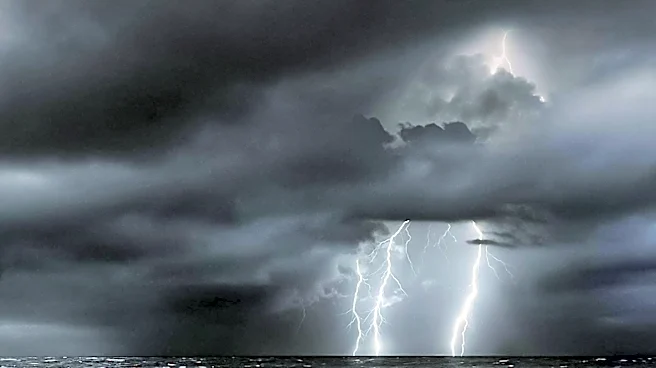
and an ER-2 aircraft, equipped with various instruments, to fly above, below, and through these clouds. The campaign aims to understand how these elusive weather phenomena form and interact with the atmosphere. During one flight, scientists unexpectedly encountered a pyroCb cloud over the Wildhorse grass fire in eastern Idaho, providing a crucial opportunity for direct measurements. The team collected data on smoke particles, gases, ice crystals, and radiation, while ground crews also monitored wildfires. This research is critical because pyroCbs can inject smoke 30,000 to 50,000 feet into the atmosphere, reaching altitudes comparable to commercial jets and even the stratosphere, where smoke can persist for extended periods and spread globally.
Why It's Important?
The study of pyroCb clouds is significant for several reasons, impacting both immediate wildfire management and long-term climate modeling. These clouds create their own weather, producing lightning, rain, and powerful winds that can intensify fires on the ground, posing severe risks to firefighters. A better understanding of their formation and behavior could lead to advanced warning systems, similar to those for severe thunderstorms, allowing fire managers to anticipate dangerous downdrafts and wind shifts and ensure personnel safety. Furthermore, the smoke injected into the stratosphere by pyroCbs can persist for months, affecting how much solar energy the atmosphere absorbs and how much reaches Earth’s surface. Current numerical prediction models often do not explicitly account for these effects. The data collected by INSPYRE will provide crucial information to improve these models, leading to more accurate climate predictions and a better understanding of the broader environmental impact of wildfires.
What's Next?
Following the data collection phase, the INSPYRE team will combine measurements from the Gulfstream and ER-2 aircraft with satellite and ground observations. This comprehensive dataset will then be compared with existing atmospheric models to refine and improve them. Researchers will focus on understanding how wildfire-generated clouds transport smoke upward, how these clouds transform particles and gases within the smoke, how much smoke reaches the stratosphere, and its subsequent effects. The insights gained are expected to lead to more accurate forecasts for firefighters regarding pyroCb development and their impact on fire conditions. Additionally, the improved Earth system models will provide a more precise understanding of the long-term climate and weather effects of stratospheric smoke injections from these powerful, fire-induced clouds. The next phase involves extensive analysis to interpret the findings and translate them into practical applications and enhanced scientific understanding.
Beyond the Headlines
The INSPYRE campaign delves into the complex and often overlooked interaction between wildfires and atmospheric dynamics. The ability of wildfires to generate their own weather systems, particularly pyroCbs, highlights a critical feedback loop in environmental processes. This phenomenon underscores the interconnectedness of terrestrial and atmospheric systems, where events on the ground can have far-reaching effects on global climate patterns. The ethical implications extend to how societies manage land use and respond to increasing wildfire frequencies, especially in the context of a changing climate. Understanding these clouds is not just a scientific endeavor but a crucial step in developing more resilient communities and ecosystems. The long-term shifts triggered by these developments could include altered regional weather patterns, changes in atmospheric composition, and potentially new challenges for aviation due to high-altitude smoke plumes, necessitating a reevaluation of current environmental and safety protocols.