
What's Happening?
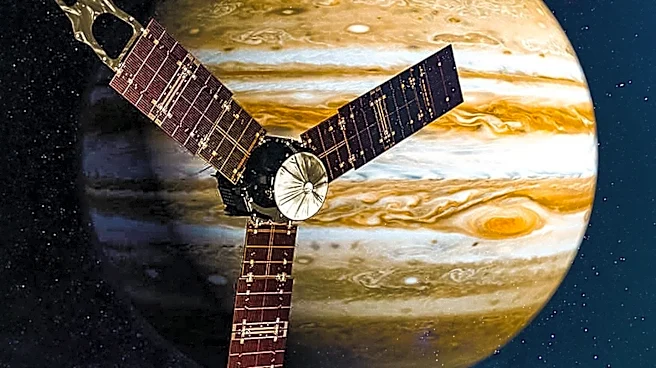
NASA's Juno spacecraft has provided new insights into the heat dynamics of Jupiter's moon Io, the most volcanic body in the Solar System. Using its Microwave Radiometer (MWR), Juno measured thermal emissions
from Io's subsurface, revealing a significant temperature increase of over 40 degrees Fahrenheit just a few feet below the surface. This steep gradient cannot be explained by solar heating alone, suggesting intense tidal heating as Io is gravitationally pulled by Jupiter and its moons. The findings, published in the Journal of Geophysical Research: Planets, offer a deeper understanding of Io's volcanic activity and its implications for other celestial bodies.
Why It's Important?
The study of Io's heat flow is crucial for understanding tidal heating, a process that affects not only Io but also other moons and exoplanets. This research provides insights into how tidal forces can generate heat and sustain volcanic activity, which is essential for assessing the potential habitability of other moons and planets. The ability to measure subsurface temperatures on Io also demonstrates the versatility of the MWR instrument, which was initially designed for Jupiter's atmosphere, highlighting its potential for future planetary exploration.
What's Next?
Future research will focus on combining MWR data with other observational techniques to map heat flux variations across Io's surface. This will help refine models of Io's internal heat distribution and volcanic activity. Additionally, the development of more specialized MWR instruments could enhance our ability to study other celestial bodies, providing a more comprehensive understanding of their thermal and physical properties.