







What's Happening?
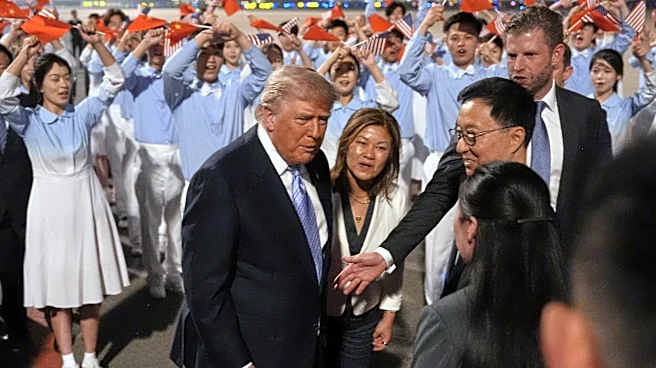
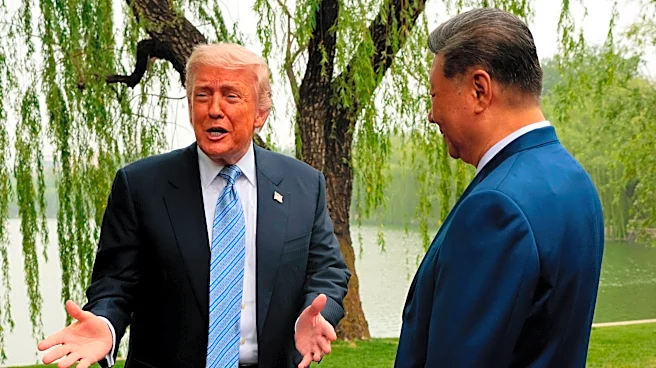
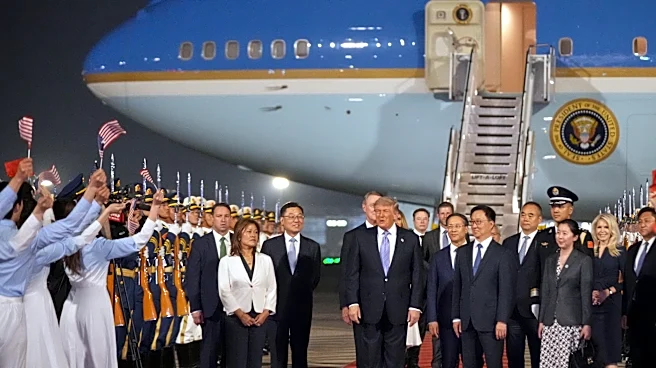
President Trump concluded a summit with Chinese President Xi Jinping in Beijing, where discussions focused on trade agreements and geopolitical tensions, particularly concerning Taiwan. The summit, held at the Zhongnanhai Garden compound, included talks
on trade, with President Trump announcing 'fantastic trade deals' involving American planes and agricultural products. However, the specifics of these deals remain unclear. The leaders also addressed the U.S.-Iran conflict, with Xi expressing a desire to help reopen the Strait of Hormuz, a critical oil passage. A significant point of contention was Taiwan, with Xi warning of potential 'clashes and even conflicts' if the issue is not managed properly. The U.S. has historically opposed any unilateral changes to Taiwan's status and has provided military support to the island, though it maintains strategic ambiguity regarding its defense commitment.
Why It's Important?
The summit between President Trump and Xi Jinping is crucial as it attempts to stabilize U.S.-China relations following a period of heightened trade tensions. The discussions on trade could have significant implications for U.S. industries, particularly agriculture and aerospace, as China is a major market for these sectors. The potential reopening of the Strait of Hormuz is also vital for global oil markets, given its role as a key transit route. The Taiwan issue remains a critical flashpoint, with China's assertive stance posing challenges to regional stability and U.S. foreign policy. The U.S.'s strategic ambiguity on Taiwan's defense could impact its diplomatic relations in the Asia-Pacific region.
What's Next?
Future developments may include further negotiations on trade agreements and potential visits, with Xi expected to visit the U.S. in September. The handling of the Taiwan issue will likely continue to be a sensitive topic, requiring careful diplomatic navigation to avoid escalation. The U.S. and China may also explore establishing a 'Board of Trade' to oversee bilateral commerce, which could help in managing economic relations. Stakeholders in both countries will be closely monitoring these developments, as they could influence global economic and geopolitical dynamics.