



What's Happening?
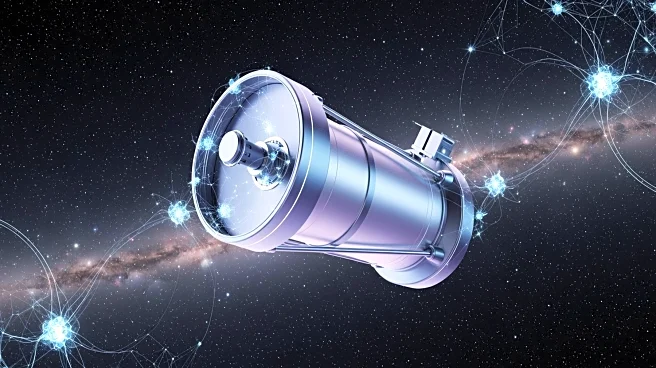
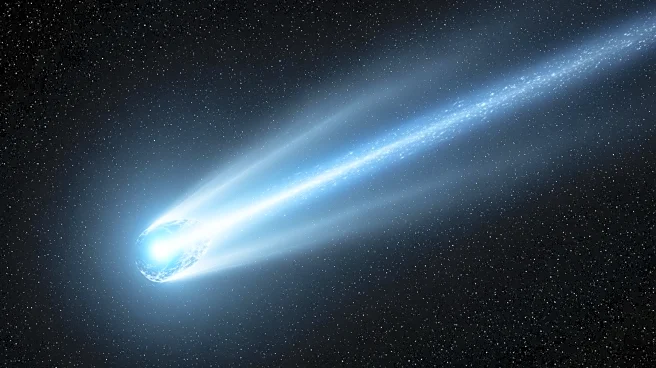
NASA's ATLAS program has confirmed that the interstellar comet 3I/ATLAS is approaching Earth, with its closest approach scheduled for December 19, 2025. The comet, which was first observed by the ATLAS survey telescope in July 2025, is on a hyperbolic
trajectory, indicating it is not gravitationally bound to the sun. This makes it only the third confirmed interstellar object to pass through our solar system, following 1I/‘Oumuamua and 2I/Borisov. The comet will pass at a safe distance of approximately 170 million miles from Earth. Despite its distance, the comet's approach is significant due to its rarity and the opportunity it presents for scientific observation. Astronomers are keen to study the comet's composition and trajectory to gain insights into the materials and conditions of other planetary systems.
Why It's Important?
The approach of 3I/ATLAS is significant for several reasons. As an interstellar object, it provides a rare opportunity to study material from outside our solar system, potentially offering insights into the formation and composition of other planetary systems. The comet's hyperbolic trajectory and high speed highlight the challenges in tracking and studying such objects, emphasizing the need for advanced observation and tracking systems. The event also serves as a reminder of the vastness and unpredictability of space, as well as the importance of international collaboration in space observation and planetary defense. The data collected during this flyby could enhance our understanding of cometary physics and improve our ability to predict and respond to potential future interstellar visitors.
What's Next?
Following its closest approach, 3I/ATLAS will continue its journey out of the solar system. Observations will continue as long as the comet remains visible, with astronomers using various telescopes and instruments to gather as much data as possible. The Virtual Telescope Project has scheduled an online broadcast for those unable to view the comet directly. The scientific community will analyze the data collected to better understand the comet's composition and trajectory, contributing to ongoing research in planetary science and interstellar objects. This event may also prompt discussions on improving detection and tracking systems for future interstellar objects.