



What's Happening?
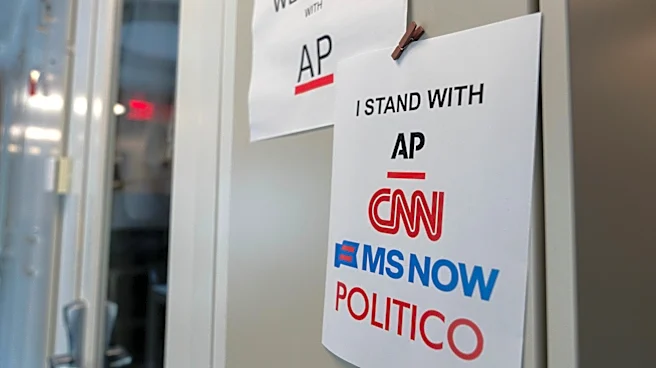
Vice President JD Vance has been identified as the 'senior administration official' who provided information for a Politico article published in June 2026. This article was one of six cited by the White House as justification for banning Politico, CNN,
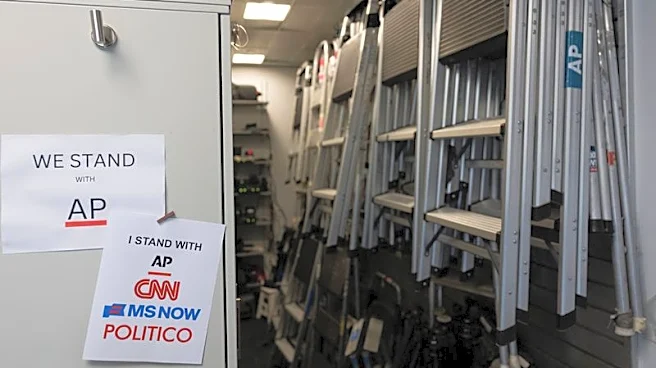
and MS NOW from the presidential press pool. The Politico story, titled 'A deal with Iran is near but not final, senior US official says,' quoted the official estimating the odds of a U.S.-Iran peace deal at 80 to 95 percent. According to The Washington Post, Vance's comments were made during an official White House press call where participating journalists were explicitly required to identify the speaker only as a 'senior administration official.' President Trump had announced the ban on these media outlets, leading to a lawsuit and a protest from other networks. Judge Timothy J. Kelly subsequently ordered the Trump administration to reinstate access for the outlets.
Why It's Important?
The identification of Vice President Vance as the anonymous source in a story used to justify a press ban raises significant questions about transparency and the administration's relationship with the media. It highlights a potential contradiction where the White House uses information provided by its own officials, under conditions of anonymity it imposed, as a basis for penalizing news organizations. This situation could erode public trust in both government communications and journalistic practices, particularly regarding the use of anonymous sources. The incident also underscores the ongoing tension between the Trump administration and certain media outlets, and the legal challenges that arise when press access is restricted. The judge's order to reinstate access reaffirms the importance of a free press and its role in covering the executive branch.
What's Next?
Following Judge Timothy J. Kelly's order, Politico, CNN, and MS NOW are expected to have their access to the presidential press pool reinstated. However, the broader implications of this incident for White House press relations remain to be seen. The administration may face continued scrutiny regarding its criteria for press access and its use of anonymous sources. Media organizations might re-evaluate their policies on accepting information from officials under conditions of anonymity, especially when such information is later used against them. This event could also prompt further discussions and potential policy changes regarding the rules of engagement between the White House and the press corps, aiming to clarify guidelines for official press calls and the attribution of sources.
Beyond the Headlines
This event delves into the complex ethical and practical considerations surrounding anonymous sources in political journalism. While anonymity can be crucial for officials to share sensitive information without fear of reprisal, its use by the administration to then justify a press ban creates a problematic precedent. It highlights a power dynamic where the government can control the flow of information and then weaponize that control against media outlets. This situation could lead to a chilling effect on whistleblowers or officials willing to speak off the record, as the integrity of such agreements is called into question. Furthermore, it underscores the ongoing debate about media credibility and the challenges news organizations face in navigating an environment where their reporting can be labeled as 'fake news' even when based on official, albeit anonymous, sources.