
What's Happening?
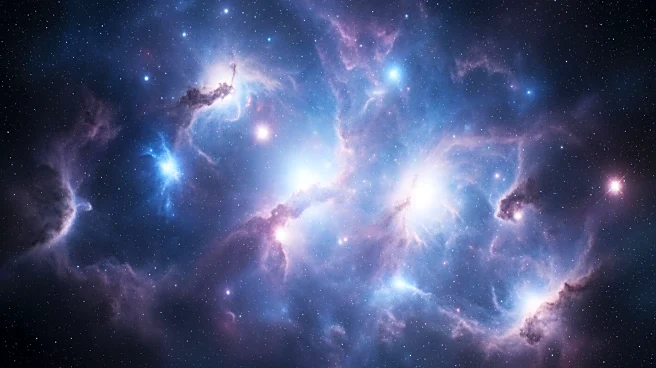
NASA's Hubble Space Telescope has captured a detailed image of the Lupus 3 cloud, a star-forming region located approximately 500 light-years away in the constellation Scorpius. The image reveals a landscape
filled with gas and dust, where new stars are actively forming. Among these are T Tauri stars, which are in a specific stage of star formation characterized by the dissipation of surrounding gas and dust due to radiation and stellar winds. These stars, typically less than 10 million years old, exhibit variations in brightness due to instabilities in their accretion disks and other factors. The study of T Tauri stars provides valuable insights into the star formation process, as they are in the process of contracting under gravity to become main sequence stars.
Why It's Important?
The observation of the Lupus 3 cloud and its T Tauri stars is significant for understanding the early stages of star formation. By studying these young stars, astronomers can gain insights into the processes that lead to the formation of main sequence stars, which are crucial for the development of planetary systems. This research contributes to the broader understanding of stellar evolution and the conditions necessary for the formation of stars and planets. The findings also enhance our knowledge of the dynamics within star-forming regions, which can influence the formation and evolution of galaxies.