




What's Happening?
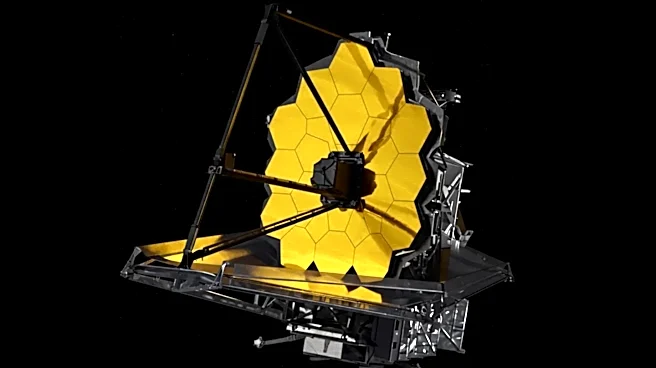
The James Webb Space Telescope (JWST) has been observing supermassive black holes in the early universe that appear to be hundreds of millions of times the mass of the sun, seemingly too large to have formed within the first billion years of the universe's
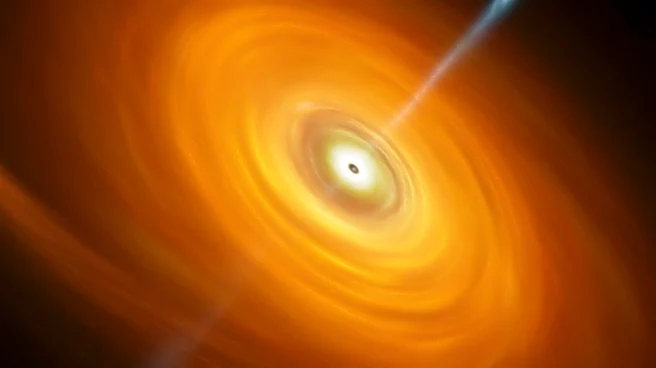
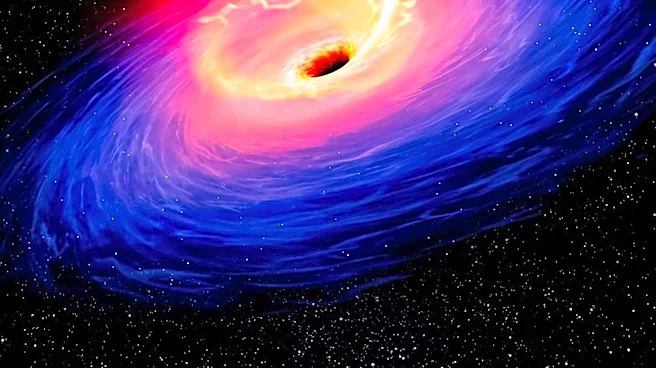
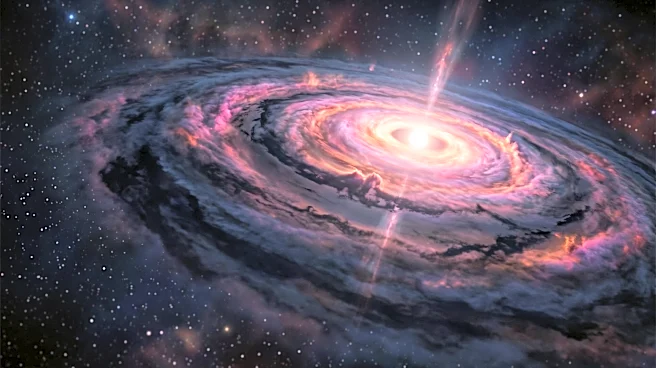
existence. These observations have challenged existing theories about black hole growth rates and their relationship with host galaxies. New research, led by Alessandro Trinca of the Italian National Institute for Astrophysics (INAF) Astronomical Observatory of Rome, suggests that these early supermassive black holes may not be as massive as initially estimated. The team proposes that the apparent lack of strong X-ray emissions from these black holes, which would typically be expected from rapidly feeding black holes, is a key indicator. They suggest that the disk of gas around these black holes becomes geometrically thick, scattering X-rays and making the black holes appear fainter than they are. This re-evaluation leads to mass estimates of roughly one to ten million solar masses, significantly lower than previous inferences, and more consistent with the sizes of their host galaxies.
Why It's Important?
This re-evaluation of supermassive black hole masses in the early universe has significant implications for astrophysics and our understanding of cosmic evolution. If the new estimates are accurate, it means that the growth history of these black holes is less extreme than previously thought, requiring shorter episodes of very rapid accretion rather than continuous, uninterrupted growth over hundreds of millions of years. This aligns better with the gas-rich and dynamically active environments expected in the early universe. The findings challenge the strict adherence to the Eddington limit, which posits a maximum rate for matter accretion onto black holes due to radiation pressure. The research suggests that supermassive black holes can undergo brief phases of 'super-Eddington' feeding, where they accrete matter at rates exceeding this limit. This shift in understanding could lead to revised models of galaxy formation and evolution, as the co-evolution of black holes and their host galaxies is a fundamental aspect of cosmic structure development.
What's Next?
Confirming the theory of rapid, episodic feeding for supermassive black holes will require further astronomical evidence. Researchers plan to study similar rapidly accreting objects at lower redshifts, where their environments can be characterized in greater detail, although such objects are rare. For the more distant black holes observed by JWST, future missions with deeper X-ray observations and improved spectra will be crucial to detect the weak X-ray emissions predicted by this new model. In the long term, obtaining direct and independent measurements of black hole masses at progressively earlier cosmic times will provide the strongest test of this theory. This ongoing research highlights the iterative nature of scientific discovery, where new observations from advanced instruments like the JWST can lead to significant revisions of established theories and open new avenues for understanding the universe.
Beyond the Headlines
The study's findings underscore the power of indirect evidence and the reinterpretation of seemingly anomalous observations in scientific progress. The initial 'problem' of overly massive black holes and the 'missing' X-rays, when re-examined through a new lens, became a 'clue' that led to a revised understanding. This demonstrates how scientific models are constantly refined and challenged by new data, pushing the boundaries of our knowledge. The concept of 'super-Eddington' feeding also suggests a more dynamic and perhaps chaotic early universe than previously envisioned, where extreme events played a more significant role in shaping cosmic structures. This research not only impacts our understanding of black holes but also contributes to the broader narrative of how the universe evolved from its earliest stages to the complex structures we observe today, emphasizing the interconnectedness of various astrophysical phenomena.