
What's Happening?
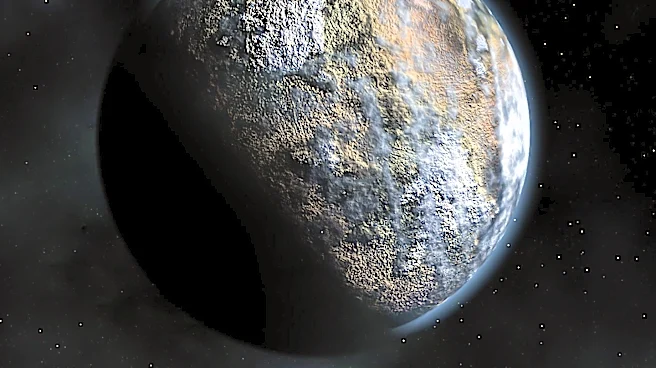
Scientists have detected signs of an atmosphere on LHS 1140b, a rocky exoplanet located 49 light-years from Earth. This 'super-Earth' is situated in the habitable zone of its star, where conditions may allow for liquid water. The discovery was made by
Collin Cherubim, a planetary scientist, who used a model to identify planets likely to retain helium in their atmospheres. Observations from the Magellan Clay telescope in Chile revealed helium escaping from LHS 1140b, suggesting the presence of an atmosphere. This finding marks a significant step in the search for habitable planets outside our solar system, as it is the first time an atmosphere has been detected on a rocky planet in a habitable zone.
Why It's Important?
The detection of an atmosphere on LHS 1140b is a breakthrough in the field of exoplanet research, offering new possibilities for the search for extraterrestrial life. The presence of an atmosphere is a key factor in determining a planet's habitability, as it can support liquid water and potentially life. This discovery could lead to further studies of similar exoplanets, enhancing our understanding of planetary formation and evolution. The findings also highlight the potential of red dwarf stars as hosts for habitable planets, despite their volatile nature. This research could influence future missions and the prioritization of targets for telescopes like the James Webb Space Telescope.
What's Next?
Further observations are needed to confirm the presence of an atmosphere on LHS 1140b and to identify other potential gases, such as oxygen, that could indicate habitability. Researchers plan to use more sensitive instruments and telescopes, including the James Webb Space Telescope, to gather additional data. The scientific community is eager to explore whether other rocky exoplanets in similar conditions also possess atmospheres. This ongoing research could provide insights into the prevalence of habitable planets in the universe and guide future exploration efforts.