







What's Happening?
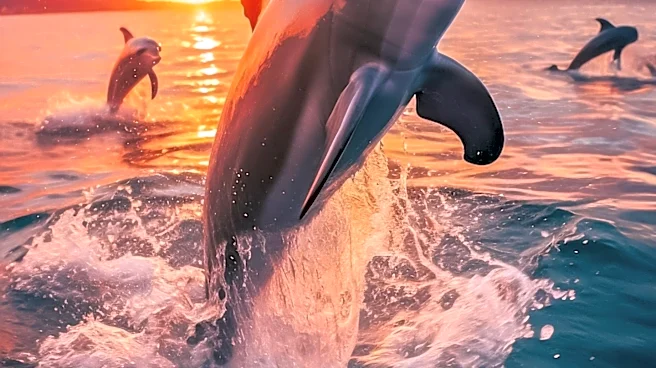
Bottlenose dolphins in two geographically distinct populations in Australia, separated by nearly 4,000 kilometers, have independently developed a unique foraging technique known as 'shelling.' This behavior involves using large empty sea-snail shells
to trap fish, carrying the shell to the surface, and then tipping it to drain the prey into their mouths. Researchers have observed this behavior in Shark Bay on Australia's west coast for years and have now published the first records from Queensland's Great Sandy Marine Park on the east coast. The significant distance between these populations suggests that the dolphins independently innovated this tool-use behavior, rather than learning it from each other. The technique requires complex steps, including locating a suitable shell, exploiting a fish's tendency to hide, orienting the shell during ascent, and draining it without losing the meal.
Why It's Important?
This discovery is significant for understanding animal cognition, tool use, and cultural transmission in non-human species. The independent development of such a complex foraging strategy in two separate populations challenges previous assumptions about how advanced behaviors spread and evolve within animal societies. It suggests that similar ecological pressures and cognitive abilities can lead to convergent evolution of sophisticated tool use. For the scientific community, particularly in marine biology and ethology, this provides compelling evidence for independent innovation and potentially for the existence of 'culture' in dolphin populations, where learned behaviors are passed down or across social networks. It also highlights the adaptability and problem-solving capabilities of dolphins, reinforcing their status as highly intelligent marine mammals.
What's Next?
Future research will likely focus on further investigating the mechanisms of learning and transmission of shelling within these dolphin populations. Scientists will aim to conduct longer observations, track individual life histories, and gather social-network data to understand how often this behavior occurs and how it is acquired by calves or peers. The observation of a calf, Bentley, attempting to replicate its mother Maserati's shelling technique shortly after watching her, provides a potential avenue for studying vertical social learning. Researchers will also seek to determine if there are other instances of shelling in different dolphin populations globally, which could further illuminate the environmental factors and cognitive predispositions that lead to such innovations. Understanding these processes could offer insights into the origins of tool use and cultural development in other species, including humans.
Beyond the Headlines
The independent invention of shelling by dolphins offers a fascinating parallel to human innovation and cultural development. It underscores that complex problem-solving and tool use are not exclusive to humans and can arise spontaneously in different groups facing similar environmental challenges. This phenomenon challenges anthropocentric views of intelligence and culture, suggesting that the capacity for innovation and social learning is more widespread in the animal kingdom than often assumed. The study also implicitly raises questions about conservation, as understanding the cognitive and cultural richness of species like dolphins can strengthen arguments for their protection. Recognizing their capacity for complex behaviors and cultural transmission adds another layer of appreciation for the intricate lives of marine animals and the importance of preserving their habitats.