



What's Happening?
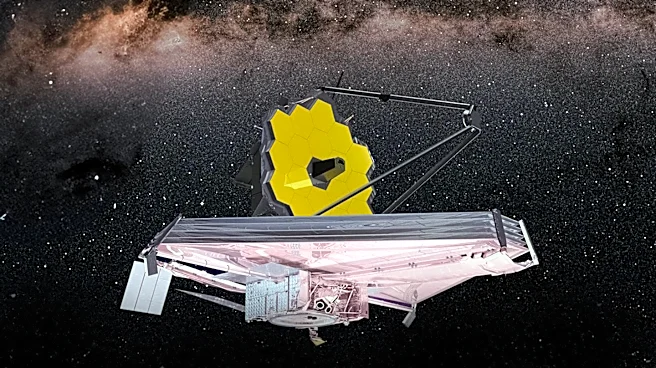
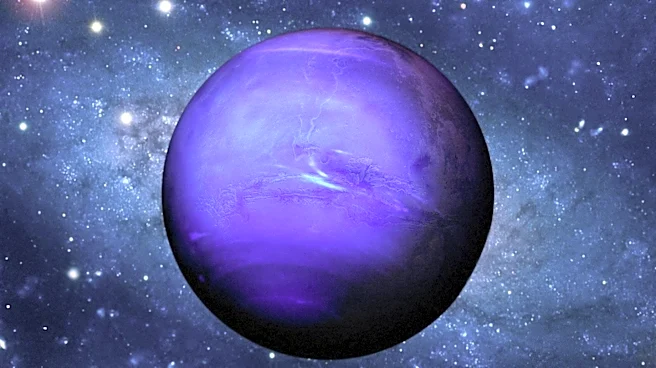
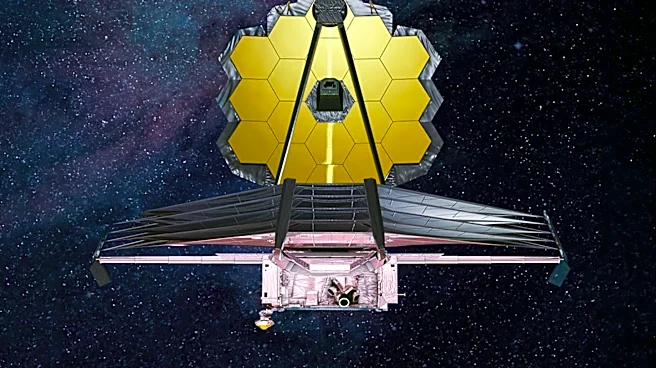
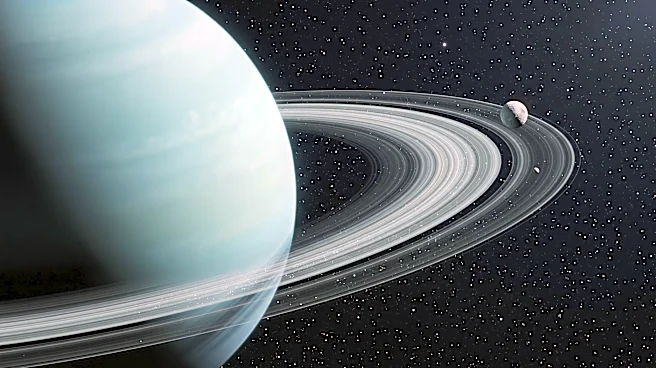
A new study led by Matthew Belyakov at the California Institute of Technology, utilizing the James Webb Space Telescope (JWST), has provided the first 1–5 micron spectra of Uranus’s ring-moon system. The research, published in ApJL 1010 L18, reveals that
the rings and small inner moons of Uranus, including Puck, Perdita, Portia, and Juliet, exhibit compositions remarkably similar to water-type Kuiper Belt objects (KBOs). The JWST's Near-Infrared Spectrograph (NIRSpec) instrument was used to obtain spectra, showing evidence of water ice, water-ice grains, and carbon dioxide ice. The study found that volatile abundances increase with distance from Uranus, supporting a theory of ring-moon cycling where collisions between moons form rings, and new moons then coalesce from this material. This detailed spectral analysis offers new insights into the formation and evolution of Uranus's complex satellite system.
Why It's Important?
This research is significant because it sheds new light on the origins of Uranus's ring-moon system, a region previously difficult to observe due to the small size and proximity of the moons to the planet. The discovery of Kuiper Belt-like compositions suggests two plausible formation scenarios: either a water-type KBO was responsible for the impact that tilted Uranus, with the rings and moons accreting from the resulting debris disk, or the inner moons formed after the main satellites from a tidally disrupted KBO. Understanding these formation mechanisms contributes to a broader comprehension of planetary system development and the distribution of materials in the early solar system. The findings also highlight the advanced capabilities of the JWST in unraveling the mysteries of distant celestial bodies, pushing the boundaries of astronomical observation and analysis.
What's Next?
To further refine the understanding of Uranus's ring-moon system, additional measurements of the deuterium-to-hydrogen ratio of the inner ring-moon system are needed. These measurements would help to more precisely determine the relationship between the inner moons and the proposed KBO impactor. Future observations with advanced telescopes like the JWST could also focus on identifying other mineralogical components or subtle spectral differences that might distinguish between the two proposed formation theories. Continued study of Uranus's unique characteristics, such as its lopsided rotation and dynamic satellite system, will contribute to a more complete picture of how giant planets and their accompanying systems evolve over cosmic timescales.
Beyond the Headlines
The implications of this study extend beyond Uranus, offering valuable insights into the broader processes of planet formation and the dynamics of celestial bodies in the outer solar system. The similarity between Uranus's inner moons and KBOs suggests a common origin or shared evolutionary pathway, potentially linking the formation of giant planet satellite systems to the primordial disk of debris from which the solar system formed. This research also underscores the importance of studying 'ice giants' like Uranus and Neptune, which are less understood than gas giants like Jupiter and Saturn. Unraveling their histories can provide crucial data for exoplanet research, helping scientists to better interpret observations of distant planetary systems and understand the diversity of planetary architectures across the galaxy.