








What's Happening?
Consumer Reports has released new guidance emphasizing the importance of distraction-free driving, particularly in modern vehicles equipped with complex screens and controls. The organization highlights that while keeping eyes on the road is a fundamental
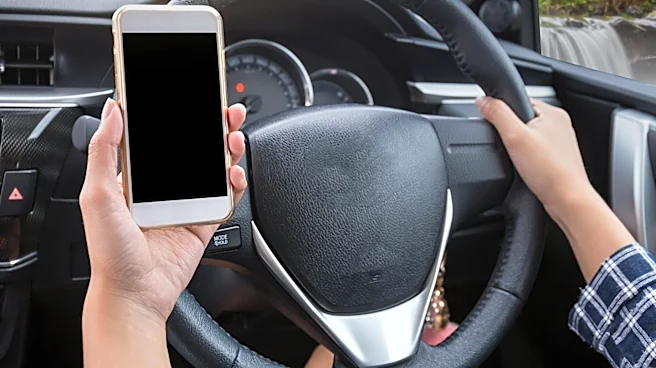
driving lesson, it has become increasingly challenging due to in-car distractions. Maddie McCarty, a human factors engineer at Consumer Reports’ Auto Test Center, evaluates the ease of use for controls in new cars and trucks. She notes that some controls are more distracting than others, especially those critical for safe driving such as windshield wipers, headlights, high beams, and defrosters, which should be quick and easy to operate. Consumer Reports advises drivers to familiarize themselves with their car's features before driving, setting up customizations while parked to minimize distractions on the road. The report also addresses the persistent issue of cell phone use while driving, noting that over one in five drivers admit to smartphone-based distractions on most trips, despite the dangers and illegality. Even a two-second glance away from the road can double the risk of a crash, prompting the recommendation to pull over safely to use a phone for texting.
Why It's Important?
This guidance from Consumer Reports is important for U.S. drivers as it addresses a growing safety concern on national roads: driver distraction stemming from both personal devices and increasingly complex vehicle interfaces. The proliferation of advanced infotainment systems and digital controls in new cars, while offering convenience, can inadvertently divert a driver's attention from the primary task of operating the vehicle safely. This issue has significant implications for public safety, potentially leading to an increase in accidents, injuries, and fatalities. For the automotive industry, the report underscores the need for human-centered design in vehicle controls, balancing technological advancement with intuitive and safe operation. Insurers may also see this as a critical factor influencing accident rates and premium adjustments. Furthermore, the continued prevalence of smartphone use while driving highlights a societal challenge that requires ongoing public awareness campaigns and enforcement efforts to mitigate risks. The advice to pre-configure vehicle settings and pull over for phone use offers practical steps for drivers to enhance their safety and the safety of others on the road.
What's Next?
In response to these concerns, it is likely that automotive manufacturers will face increased pressure to design more intuitive and less distracting in-car control systems. This could lead to a greater emphasis on physical buttons for critical functions or more advanced voice command systems that minimize visual interaction. Consumer advocacy groups and safety organizations may amplify calls for stricter regulations regarding in-vehicle technology and driver distraction. Law enforcement agencies might continue to enhance efforts to combat distracted driving, particularly concerning cell phone use, through public awareness campaigns and enforcement. Drivers are encouraged to proactively adopt the recommended practices, such as familiarizing themselves with vehicle controls before driving and avoiding cell phone use while in motion. Dealerships may also play a role by offering more comprehensive tutorials on vehicle features to new car owners, potentially free of charge, to ensure drivers understand how to safely operate their vehicles' advanced systems.
Beyond the Headlines
The issue of driver distraction extends beyond immediate safety concerns, touching upon broader ethical and technological considerations. As vehicles become more autonomous, the transition period presents a unique challenge where drivers are expected to monitor advanced systems while still being prepared to take control. This hybrid responsibility can create new forms of cognitive distraction. The report also implicitly raises questions about the balance between consumer demand for advanced features and the imperative for road safety. There's a cultural dimension to smartphone use, where constant connectivity has become ingrained, making it difficult for many to disengage even while driving. This highlights a societal dependency that technology and policy must address. The long-term implications could include a re-evaluation of driver education programs to incorporate training on managing in-car technologies and a shift in automotive design philosophy towards prioritizing safety and simplicity over feature overload. Ultimately, the goal is to foster a driving environment where technology enhances safety rather than compromises it.