







What's Happening?
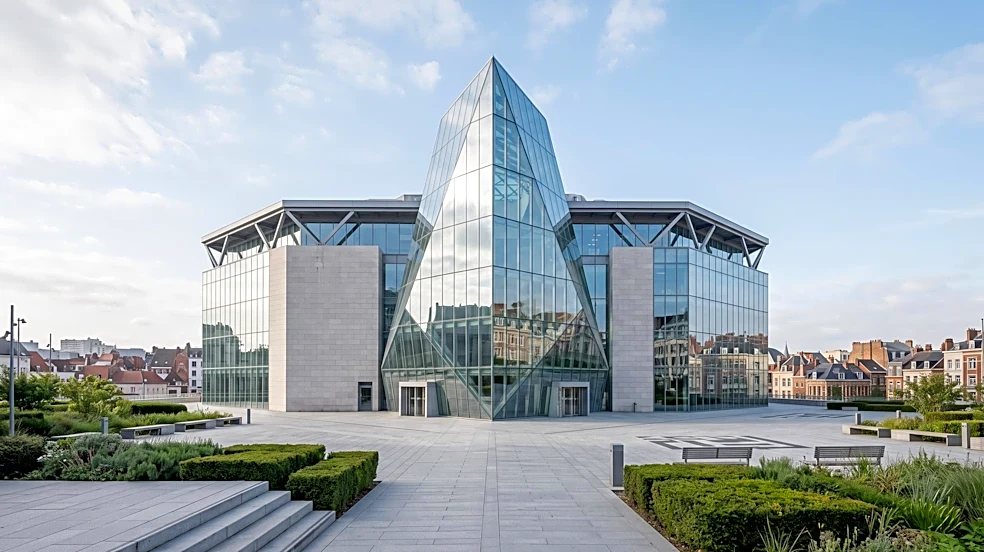
The Dutch studio OMA has unveiled the Palais de Justice de Lille, a new hexagonal glass courthouse located in Lille, northern France. This contemporary structure features a striking glass facade and is designed to blend with its natural surroundings and historical
context. The building's design draws inspiration from the nearby 1667 star-shaped fortress built by Sébastien Le Prestre de Vauban, echoing its pointed, hexagonal form. The courthouse is composed of three distinct volumes: a public entryway housing major courtrooms, a triangular central tower for minor courtrooms, and a faceted ring of offices that maximizes natural light. OMA emphasized that each volume utilizes unique materials and spatial characteristics to aid orientation and create a welcoming, non-intimidating environment. The project also incorporates outdoor spaces, including a public plaza and a rooftop garden offering panoramic views of Lille, aiming to provide tranquility and foster community engagement.
Why It's Important?
The completion of the Palais de Justice de Lille by OMA represents a significant architectural achievement that harmonizes modern design with historical urban landscapes. This project showcases how contemporary structures can draw inspiration from their historical surroundings, creating a dialogue between past and present. The courthouse's design, with its emphasis on natural light, welcoming spaces, and integration of outdoor environments, could influence future public building designs, particularly in urban settings where historical preservation and modern functionality often present challenges. The inclusion of public plazas and rooftop gardens highlights a growing trend in urban planning to incorporate green spaces and community areas into civic architecture, enhancing accessibility and public engagement. This development could serve as a model for other cities looking to update their infrastructure while respecting their heritage and promoting public welfare.
What's Next?
The Palais de Justice de Lille is now operational, serving as a key judicial institution in northern France. Its design and functionality will likely be observed by architects, urban planners, and civic leaders globally as an example of integrating modern architecture into historic urban fabrics. The success of its public spaces and the overall user experience will be crucial in determining its long-term impact and potential as a benchmark for future projects. OMA, known for its innovative projects, will continue to contribute to architectural discourse, and this courthouse will be added to their portfolio of notable works, potentially influencing their future commissions and design philosophies. The building's performance in terms of sustainability and public reception will also be monitored, providing valuable insights for future architectural endeavors.
Beyond the Headlines
Beyond its immediate function as a courthouse, the Palais de Justice de Lille embodies a broader philosophical approach to urban development and public architecture. The design's conscious effort to echo the historical fortress suggests a deeper engagement with the concept of continuity and evolution in urban identity, rather than a stark break from the past. The creation of welcoming, non-intimidating spaces within a judicial building challenges traditional perceptions of such institutions as austere and inaccessible, potentially fostering greater public trust and engagement with the legal system. Furthermore, the integration of green spaces and panoramic views reflects a growing societal value placed on well-being and connection to nature, even within highly functional urban structures. This project could spark discussions on how public buildings can serve not only their primary purpose but also contribute to the cultural, social, and environmental health of a city.