



What's Happening?
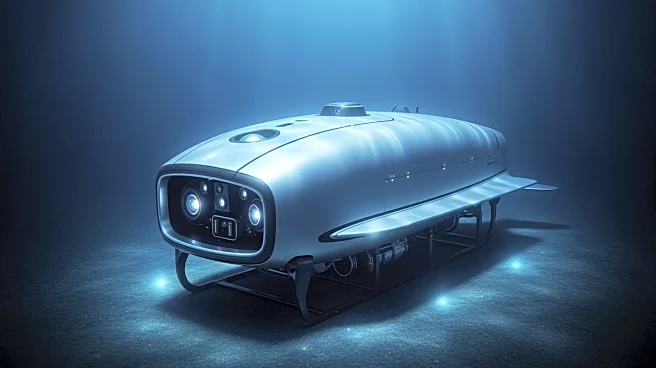
Lockheed Martin has introduced a new uncrewed undersea vehicle named Lamprey, designed to attach itself to the hulls of ships and submarines. This multi-mission autonomous undersea vehicle (MMAUV) features a modular design that allows it to launch aerial
drones, torpedoes, and decoys, as well as gather intelligence. The Lamprey is electrically powered and includes a hydrogenerator for recharging its batteries during missions. It can perform a variety of tasks, including intelligence, surveillance, reconnaissance, and targeting. The vehicle's unique capability to latch onto ships and submarines is inspired by the lamprey eel, which uses suction cup-like mouths to attach to hosts. This feature allows the Lamprey to covertly deploy and potentially disrupt enemy naval operations.
Why It's Important?
The introduction of the Lamprey represents a significant advancement in naval warfare technology, offering the U.S. Navy new capabilities for covert operations and sea denial. Its ability to attach to vessels and deploy various payloads could enhance the Navy's strategic options in contested environments. The Lamprey's modular design and autonomous operation provide a cost-effective solution for monitoring and potentially disrupting enemy movements. This development could shift naval strategies, as adversaries may need to adapt to counter the new threat posed by such autonomous systems. The Lamprey's potential to launch aerial drones and torpedoes further extends its operational reach, making it a versatile tool in modern naval warfare.
What's Next?
As Lockheed Martin continues to develop the Lamprey, further details about its range, speed, and operational capabilities are anticipated. The U.S. Navy may conduct trials to evaluate its effectiveness in various scenarios. The deployment of the Lamprey could lead to changes in naval tactics, with increased emphasis on countering autonomous threats. Other nations may also accelerate their development of similar technologies to maintain strategic parity. The integration of the Lamprey into naval operations could prompt discussions on the ethical and legal implications of using autonomous systems in warfare.
Beyond the Headlines
The Lamprey's introduction highlights the growing trend towards autonomous systems in military applications. This shift raises questions about the future role of human operators in warfare and the potential for autonomous systems to make independent decisions. The ethical considerations of deploying such technology, particularly in terms of accountability and control, will likely become a topic of debate. Additionally, the Lamprey's capabilities could influence international arms control discussions, as nations seek to regulate the use of autonomous weapons systems.