





What's Happening?
The Trump administration has significantly cut climate funding across various federal agencies, impacting critical research efforts, particularly in the Arctic. The National Oceanic and Atmospheric Administration (NOAA) withdrew its support for the Arctic Report
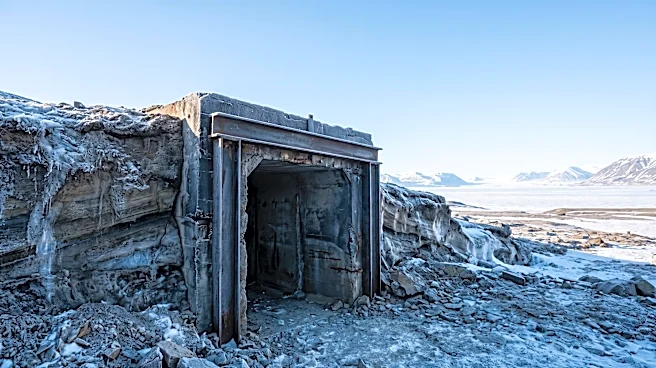
Card this summer, a key document that has tracked Arctic changes for two decades. Scientists applying for federal grants are reportedly being discouraged from using the term 'climate change' in their proposals, instead being prompted to use euphemisms like 'subseasonal variability.' Despite these cuts and the administration's stance on climate change, the U.S. military continues to require a deep understanding of the warming Arctic due to national security implications. The Army Corps of Engineers’ Cold Regions Research and Engineering Laboratory, for instance, uses permafrost tunnels to study how frozen ground affects military infrastructure and operations, and for subterranean combat training.
Why It's Important?
The reduction in federal climate research funding, especially concerning the Arctic, creates a significant knowledge gap that could have long-term consequences for the United States. The Arctic is warming at an accelerated rate, impacting permafrost stability, sea levels, and weather patterns globally. Defunding climate science puts the U.S. at a disadvantage in understanding and adapting to these changes. For the military, a warming Arctic presents both challenges and opportunities, including new shipping routes, access to natural resources, and the need to adapt infrastructure built on thawing permafrost. Without comprehensive climate data and research, military planning and operations in the region could be compromised, potentially affecting national security and geopolitical standing against competitors like Russia and China. The discouragement of using 'climate change' terminology also hinders clear scientific communication and policy development.
What's Next?
Despite federal cuts, some climate research relevant to national security may continue under military auspices, as the Department of Defense recognizes the undeniable impacts of a changing climate on its operations. However, this military-driven research may not fully compensate for the broader scientific understanding lost due to cuts in civilian agencies like NOAA and NASA. Experts warn that rebuilding the scientific workforce and data collection capabilities will require significant time, money, and effort. The long-term consequences of these funding decisions will likely manifest in reduced predictive capabilities for extreme weather events, slower adaptation to climate impacts, and a potential decline in U.S. leadership in climate science. Scientists and advocacy groups will likely continue to highlight the critical need for robust climate research funding, emphasizing its importance for both environmental and national security.
Beyond the Headlines
The administration's approach to climate science funding and terminology has deeper implications beyond immediate research gaps. It signals a broader ideological conflict regarding scientific consensus and evidence-based policymaking. The suppression of terms like 'climate change' in grant proposals can lead to self-censorship within the scientific community, potentially stifling critical research and open discourse. This environment can erode public trust in scientific institutions and government agencies responsible for environmental stewardship. Furthermore, the reliance on military-funded climate research, while necessary for national security, risks narrowing the scope of inquiry to defense-specific applications, potentially overlooking broader ecological, social, and economic impacts that civilian research typically addresses. This situation highlights a tension between political narratives and the objective pursuit of scientific knowledge, with potential long-term consequences for the nation's ability to address complex global challenges.