



What's Happening?
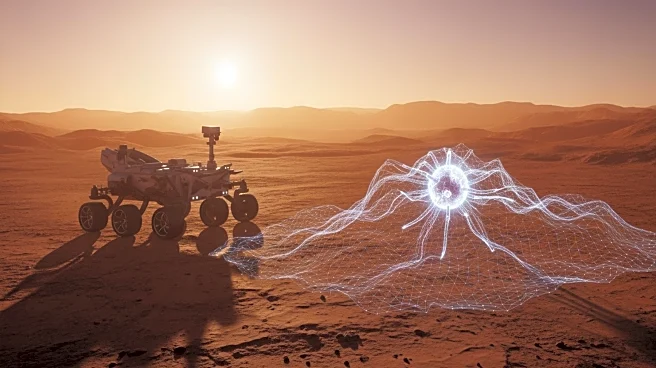
NASA's Perseverance rover has successfully used Anthropic's AI model, Claude, to map a 450-meter path on Mars. This demonstration, conducted by engineers at the Jet Propulsion Laboratory (JPL), showcases the potential of AI to enhance deep space missions.
Claude was provided with extensive data and used a unique coding language to plan the rover's route, significantly reducing the time required for route planning. This AI-driven approach could improve the efficiency of uncrewed missions to distant destinations, where communication delays pose challenges to real-time navigation.
Why It's Important?
The integration of AI in space exploration represents a significant advancement in the field, potentially transforming how missions are conducted. By reducing the time and resources needed for route planning, AI can enable more ambitious and efficient exploration of distant celestial bodies. This technology could enhance the scientific output of missions by allowing rovers to undertake more complex tasks and cover greater distances. The success of this demonstration also highlights the growing role of AI in overcoming logistical challenges in space exploration, paving the way for future missions to moons like Europa and Titan.
What's Next?
Following the successful test, NASA may consider expanding the use of AI in other aspects of space missions, such as data analysis and autonomous decision-making. The technology could be further refined to handle more complex scenarios and environments, potentially leading to its application in manned missions. As AI continues to prove its value in space exploration, collaborations between space agencies and AI developers are likely to increase, driving innovation and expanding the possibilities for future missions. The focus will be on ensuring the reliability and safety of AI systems in the challenging conditions of space.