








What's Happening?
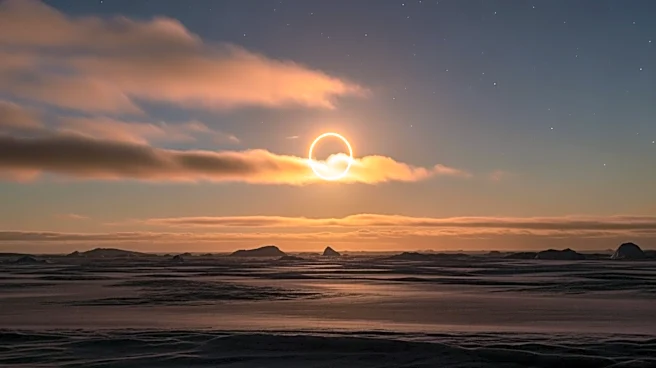
A remote research team at the Concordia Research Station in Antarctica witnessed a rare annular solar eclipse, known as a 'ring-of-fire' eclipse. This event occurred on February 17, 2026, and was visible only from the Concordia and Mirny stations. The
eclipse was characterized by the moon passing in front of the sun, leaving a bright ring of sunlight visible. Andrea Traverso, a scientist at the station, captured the event using improvised equipment, as the team had not prepared in advance for the eclipse. The unique conditions of Antarctica provided a rare opportunity for this observation.
Why It's Important?
This rare astronomical event highlights the unique research opportunities available in Antarctica, a region known for its extreme conditions and scientific significance. The ability to witness and document such an event underscores the importance of remote research stations in advancing our understanding of natural phenomena. The eclipse also serves as a reminder of the challenges and rewards of conducting scientific research in isolated and harsh environments. The images captured by Traverso contribute to the global scientific community's knowledge of solar eclipses and their effects.
Beyond the Headlines
The event emphasizes the need for preparedness and adaptability in scientific research, particularly in remote locations. The improvisation by Traverso to capture the eclipse demonstrates the resourcefulness required in such settings. Additionally, the eclipse serves as a metaphor for the broader scientific exploration of Antarctica, a region that continues to reveal new insights about our planet and its place in the solar system. The experience of the Concordia team may inspire future research initiatives and collaborations in polar science.