
What's Happening?
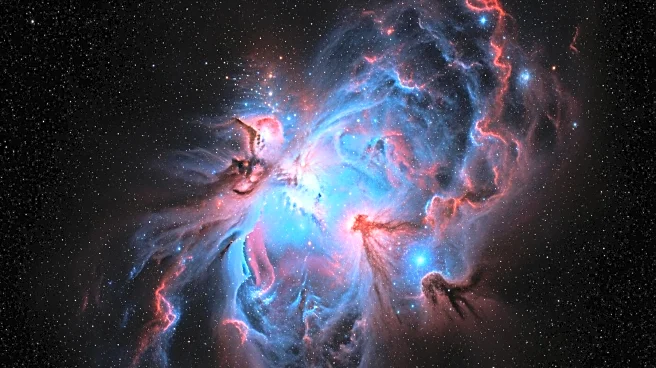
Astronomers have observed SNR G206.9+2.3, the remnants of a supernova that exploded in the Monoceros constellation approximately 7,000 light-years away. This object, although overshadowed by nearby celestial bodies like the Rosette Nebula, displays intricate,
nested shells of emission. These are caused by the supernova's blast wave interacting with surrounding gas and dust. The observation was made possible through nearly 45 hours of exposure using 2- and 4-inch refractors, employing narrowband Hα/OIII and one-shot color data.
Why It's Important?
The study of supernova remnants like SNR G206.9+2.3 is essential for understanding the life cycle of stars and the chemical enrichment of the galaxy. The shockwave's interaction with interstellar material provides insights into the processes that shape the interstellar medium. This research can inform models of stellar evolution and the distribution of elements in the universe. Additionally, such observations enhance the understanding of cosmic phenomena and contribute to the broader field of astrophysics.