




What's Happening?
New research published in Nature by neuroscientists Geoffrey Terral and Renata Batista-Brito at the Albert Einstein College of Medicine in New York has identified a specific population of cortical cells capable of initiating sleep. These cells, known
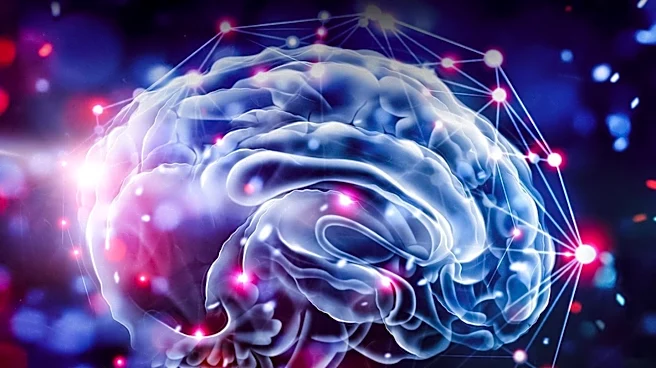
as Sst-Chodl neurons, constitute approximately one percent of the cortex's inhibitory neurons. Traditionally, sleep research has posited that the cerebral cortex passively responds to sleep signals originating from deeper brain regions. However, the study demonstrates that activating these Sst-Chodl neurons in mice is sufficient to induce sleep. This finding suggests that the cortex can not only perceive sleep rhythms but also actively initiate them, challenging the long-held assumption that subcortical regions are solely responsible for controlling sleep onset.
Why It's Important?
This discovery fundamentally shifts the understanding of how sleep is regulated in the brain. By identifying a cortical mechanism for sleep initiation, the research opens new avenues for understanding and potentially treating sleep disorders. If these Sst-Chodl neurons are indeed a primary driver of sleep, targeting them could lead to novel therapeutic interventions for insomnia, narcolepsy, and other sleep-related conditions. The fact that these cells are conserved across species, from salamanders to humans, suggests a fundamental and ancient role in sleep, making the findings highly relevant to human health. This research could also influence the development of non-pharmacological approaches to sleep management, focusing on stimulating or modulating cortical activity.
What's Next?
The research team is now focusing on three key questions: what activates these Sst-Chodl cells, whether they sense sleep pressure, and why they drive delta power, which is associated with deep, restorative sleep. Further studies will investigate the anatomy of these neurons in other brain regions, such as the prefrontal cortex, to determine if similar mechanisms are at play and if inputs from areas like the hypothalamus and thalamus trigger sleep networks. The long-term goal is to leverage this understanding to develop targeted interventions for sleep disruption, particularly in the context of psychiatric illnesses where sleep disturbances are common. This could involve developing new drugs or non-invasive brain stimulation techniques that specifically modulate the activity of Sst-Chodl neurons to promote healthy sleep.
Beyond the Headlines
The identification of Sst-Chodl neurons as potential sleep initiators has profound implications beyond medical applications. It deepens our understanding of consciousness itself, as sleep is a fundamental altered state of consciousness. The idea that a small population of cortical cells can orchestrate such a complex and vital process highlights the intricate and often localized control mechanisms within the brain. This research could also spark ethical discussions around the manipulation of sleep, particularly if precise control over sleep onset and depth becomes possible. Furthermore, the study's findings could influence the design of artificial intelligence and neural networks, providing biological insights into how complex systems transition between active and restorative states. The conserved nature of these cells across diverse species also speaks to the evolutionary importance of sleep and its underlying neural architecture.