
What's Happening?
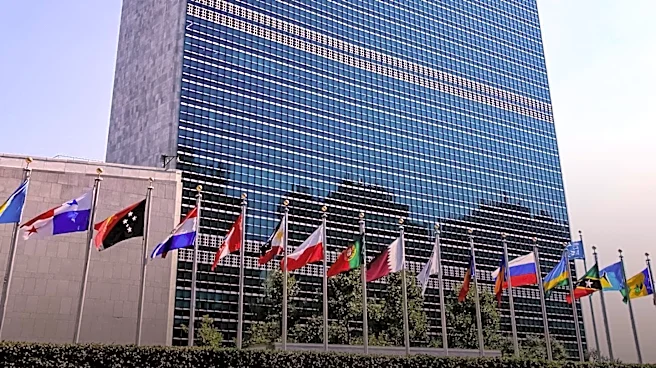
The European Union and its Member States delivered a statement to the United Nations General Assembly's Sixth Committee, focusing on the revitalization of the General Assembly's work. Mr. Fabio Cannizzaro,
Counsellor for the Delegation of the European Union to the United Nations, emphasized the ongoing collective effort required for revitalization. The statement highlighted that this session is crucial for the General Committee to present concrete proposals aimed at creating synergies and avoiding duplication across the Main Committees. Each Main Committee, including the Sixth Committee, is expected to identify up to three achievable improvements relevant to its specific work. The EU reiterated its commitment to engaging constructively with all delegations to achieve a more efficient and effective working methodology, as mandated by resolution 79/327.
Why It's Important?
The revitalization of the General Assembly's work is critical for enhancing the efficiency, effectiveness, and relevance of the United Nations as a whole. By streamlining processes and avoiding redundant efforts among its Main Committees, the UN can better address pressing global issues, from international law to human rights and sustainable development. The EU's emphasis on concrete proposals and actionable outcomes underscores the need for tangible reforms that can improve the UN's responsiveness and impact. This initiative affects how international policies are formulated and implemented, potentially leading to more coherent and impactful global governance. For the U.S., a more efficient UN could mean better allocation of resources and more effective multilateral partnerships in addressing shared challenges, aligning with broader foreign policy objectives that prioritize effective international cooperation.
What's Next?
The Sixth Committee is encouraged to continue its discussions and agree on a concrete and actionable outcome regarding its revitalization efforts. The General Committee is expected to present specific proposals based on input from each Main Committee. Changes currently under discussion for specific agenda items are considered trials, which will be reviewed based on experience, similar to how the General Assembly has handled measures under resolution 79/327. The European Union and its Member States, along with other delegations, will continue to engage constructively to achieve these goals. The aim is to foster a spirit of consensus to make the work of the committees more efficient and effective, with a draft decision currently under consideration to guide these efforts.
Beyond the Headlines
The push for revitalization within the UN General Assembly reflects a broader global demand for more agile and responsive international institutions in an increasingly complex world. Beyond procedural improvements, this initiative touches upon the fundamental legitimacy and credibility of the UN. When the General Assembly operates more efficiently, it strengthens its role as the primary deliberative, policymaking, and representative organ of the United Nations. This can lead to greater trust from member states and the global public, enhancing the UN's capacity to mobilize collective action on critical issues. The process of revitalization also serves as a continuous exercise in multilateral diplomacy, where diverse national interests must be reconciled to achieve common institutional goals, highlighting the enduring challenges and importance of international cooperation.