






What's Happening?
Canada's 2026 Budget, tabled by Finance Minister François-Philippe Champagne, formally commits to developing sovereign medium-lift rocket capabilities, a significant escalation from previous light-lift aspirations. This initiative, managed by the Department
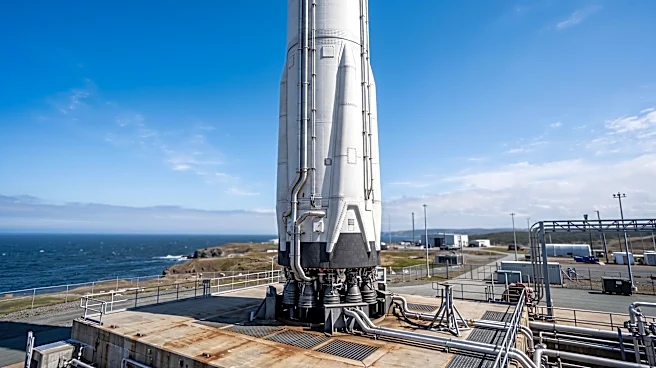
of National Defence (DND) rather than the Canadian Space Agency, aims to establish a national rocket propulsion ecosystem and government-owned launch and test infrastructure. The budget directs DND to expand its 'Launch the North' program to include medium-lift vehicles, capable of carrying 6,000 to 12,500 kilograms to low Earth orbit. This move positions space launch as a strategic military asset, with DND having already selected three companies—NordSpace, Canada Rocket Company, and Reaction Dynamics—to receive grants for developing orbital launch capabilities. The funding for this and other defense industrial priorities is allocated from a C$2.7 billion envelope over five years, though analysts note that much of this sum redistributes previously committed funds rather than representing entirely new spending. The budget also designates Atlantic Canada as the location for dedicated sovereign launch facilities, with agreements already in place for Spaceport Nova Scotia and NordSpace's Atlantic Spaceport Complex.
Why It's Important?
This strategic shift by Canada to prioritize sovereign medium-lift launch capabilities under its Department of National Defence has significant implications for national security and defense posture. By developing its own launch infrastructure and vehicles, Canada aims to reduce reliance on foreign governments and commercial providers for critical satellite deployment, ensuring the ability to place Canadian satellites into specific orbits on short notice. This is particularly crucial for military applications such as reconnaissance, signals intelligence, and communications payloads, aligning with Canada's view of space as an operational domain alongside traditional military spheres. The move also strengthens Canada's contribution to NATO's STARLIFT initiative, allowing allied satellites to be launched from Canadian soil. The involvement of DND's Innovation for Defence Excellence and Security (IDEaS) program, designed for rapid iteration and milestone-gated competitive support, is intended to accelerate development and ensure accountability, contrasting with the longer procurement timelines typical of civilian space agencies. This focus on domestic control and military integration underscores a broader trend among allied nations to secure independent space access for defense purposes.
What's Next?
The immediate next steps involve DND offering competitive, milestone-based support to companies developing propulsion systems, vehicle designs, and launch technologies for the medium-lift class. Construction on NordSpace's Atlantic Spaceport Complex, including a six-kilometer road to the orbital launch area, is slated to begin in spring 2027, with an orbital launch projected no earlier than 2028. While the budget provides political authority and institutional clarity for the medium-lift objective, a separate federal procurement vehicle will be required to transition from IDEaS-funded prototypes to sustainably procured, operationally contracted launch services. This framework does not yet exist, and its development will be crucial for converting prototype success into operational capability. The Canadian Space Agency's new president, Alex MacDonald, will also need to define the agency's role and future budget requests within this new military-led launch environment. The long-term success will depend on how effectively Canada can bridge the gap between prototype development and operational deployment, especially as the commercial space landscape evolves with the anticipated wind-down of SpaceX's Falcon 9, which could create a near-term gap in affordable medium-lift access.
Beyond the Headlines
The decision to place Canada's sovereign launch program under the Department of National Defence rather than the Canadian Space Agency reflects a profound re-evaluation of space as a critical domain for national security. This move signifies a shift from viewing space primarily through a scientific or commercial lens to recognizing its direct military utility and strategic importance in a destabilized global environment. The emphasis on 'sovereign intelligence systems' and 'domestic control' highlights a broader geopolitical trend where nations are increasingly seeking self-reliance in critical technological areas to protect national interests and maintain strategic autonomy. The budget's structure, which reallocates existing defense industrial funding rather than providing substantial new money, suggests a strategic prioritization within current resources, potentially indicating a long-term commitment to building domestic defense capabilities. This approach could foster a robust domestic defense industrial base, creating jobs and technological advancements within Canada, but also raises questions about the transparency of funding and the potential for industrial benefits to overshadow military capability needs, as noted by some analysts.