
What's Happening?
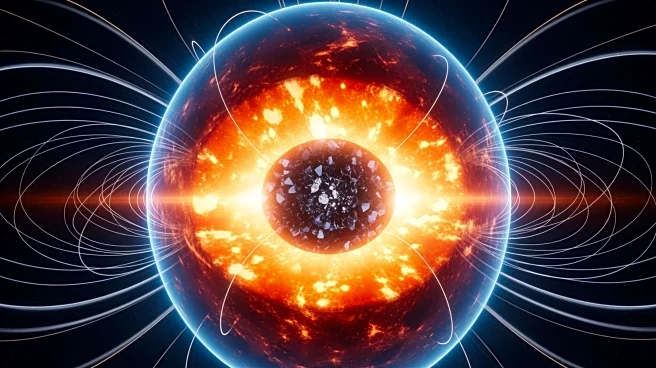
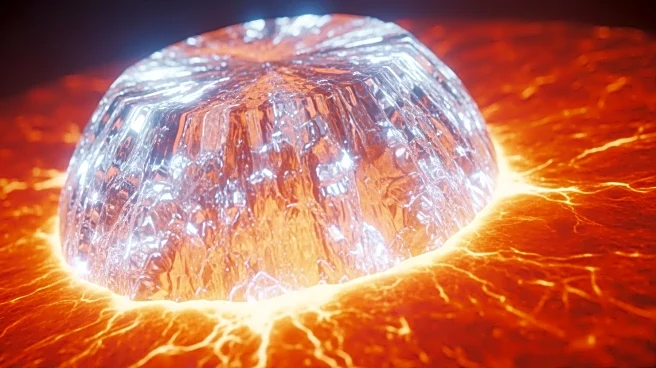
Researchers have discovered a new state of matter in Earth's inner core, known as a superionic state, where light elements move through a stable iron framework as if they were liquid. This finding, published
in the National Science Review, challenges previous understandings of the inner core's behavior. The study, led by Prof. Youjun Zhang and Dr. Yuqian Huang, demonstrates that under extreme conditions, iron-carbon alloys in the inner core shift into this superionic phase. This discovery helps explain the inner core's unusual seismic properties, such as its ability to slow seismic shear waves and its low rigidity.
Why It's Important?
The discovery of a superionic state in Earth's inner core has significant implications for our understanding of the planet's internal dynamics. It provides a new perspective on how the inner core contributes to Earth's magnetic field and seismic anisotropy. The fluid-like motion of light elements within the core could represent an additional energy source for the geodynamo, which sustains Earth's magnetic field. This research also advances our knowledge of how light elements behave under extreme pressure, potentially influencing studies of other rocky planets and exoplanets.
Beyond the Headlines
This discovery marks a shift from viewing the inner core as a static, rigid structure to understanding it as a dynamic system. The identification of a superionic phase could lead to new insights into the magnetic and thermal evolution of Earth-like planets. The research highlights the importance of interstitial solid solutions in controlling the core's physical properties, offering a new framework for interpreting seismic data. This breakthrough could pave the way for future studies on planetary interiors and their evolution.