







What's Happening?
Over the last decade, Japan has significantly enhanced its system for responding to security crises, enabling faster action. Key institutional reforms include the establishment of the National Security Council (NSC) in 2013 and the National Security Secretariat
(NSS) in 2014. In May 2026, Japan further implemented significant intelligence reforms by creating a prime minister-chaired National Intelligence Council and a coordinating National Intelligence Bureau. These changes have shifted Japan's security decision-making from a reliance on precedent and process to a more comprehensive approach that integrates legal interpretation, political management, coordination with allies like the United States and Australia, military advice, and technical expertise. The new structures aim to centralize strategic planning and interagency coordination, replacing fragmented approaches with a more unified system.
Why It's Important?
Japan's strengthened crisis response system is critically important for U.S. interests, particularly given the robust U.S.-Japan alliance and shared security concerns in the Indo-Pacific. A more agile and decisive Japan enhances regional stability and strengthens the collective deterrence against potential adversaries. Improved coordination mechanisms, such as those between the Japanese NSC and NSS and their U.S. counterparts, facilitate quicker and more effective responses to contingencies, from natural disasters to military threats. This enhanced capability means that in a crisis, the U.S. can expect a more streamlined and integrated response from a key ally, which is vital for joint operations and strategic alignment in a complex security landscape.
What's Next?
The ongoing reforms suggest a continued evolution of Japan's security posture, moving towards a more proactive stance. Future developments will likely include further refinement of legal frameworks for emergencies, continued integration of intelligence and policy-making, and deeper coordination with allies. The establishment of the Japan Joint Operations Command (JJOC) and the upgrading of U.S. Forces Japan into a joint force headquarters indicate a trajectory towards more integrated military command structures. These changes will necessitate continuous dialogue and joint exercises between the U.S. and Japan to ensure interoperability and mutual understanding of evolving crisis response protocols. The effectiveness of these reforms will be tested in future regional contingencies, shaping the future of the U.S.-Japan alliance.
Beyond the Headlines
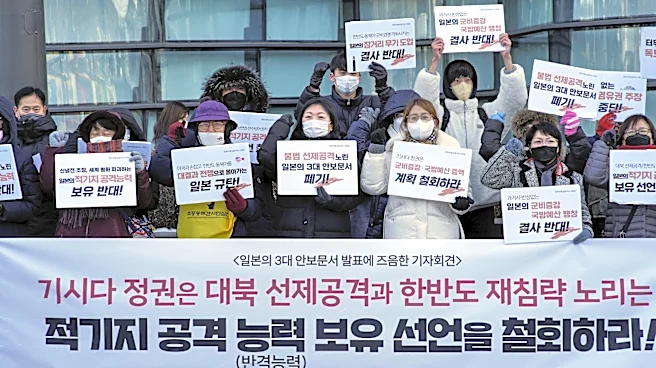
Beyond the operational improvements, Japan's security reforms reflect a deeper societal shift in its approach to national defense, moving away from a purely pacifist interpretation of its constitution. This evolution has significant implications for regional power dynamics and the balance of influence in Asia. The internal debates and political management required to implement these reforms highlight the complex interplay between historical sensitivities, public opinion, and geopolitical realities. For the U.S., understanding these internal dynamics is crucial for effective alliance management and for supporting Japan's role as a security provider in the region. The reforms also raise questions about the balance between centralized decision-making and democratic oversight, a challenge that many nations, including the U.S., grapple with in national security contexts.