
What's Happening?
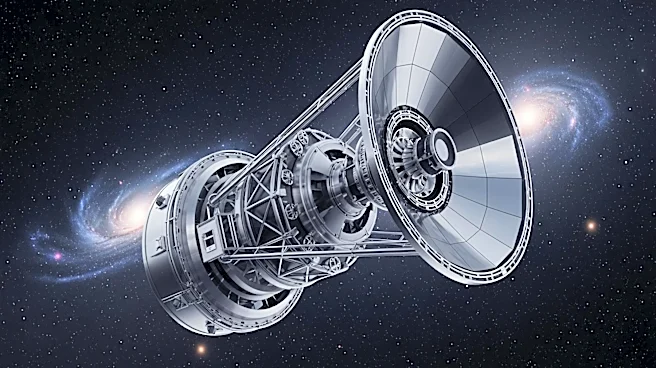
Scientists have completed a groundbreaking 3D map of the universe using the Dark Energy Spectroscopic Instrument (DESI), which recorded over 47 million galaxies and quasars. This map is the most detailed
high-resolution representation of the universe ever created, providing new insights into its structure and evolution. The project, led by the Department of Energy's Lawrence Berkeley National Laboratory, involved more than 900 researchers from over 70 institutions. Ohio State University played a significant role in the project, contributing to instrumentation, operations, and analysis. Despite challenges such as the Contras wildfire in 2022, the team successfully completed the survey ahead of schedule.
Why It's Important?
The completion of DESI's 3D map is a major milestone in understanding dark energy, which is believed to constitute about 70% of the universe. The data collected will allow researchers to test theories about the balance between dark energy and matter, potentially leading to significant changes in our understanding of the universe. The project has already gathered measurements from six times more galaxies and quasars than previous surveys, providing a robust foundation for future research. The findings could impact cosmological models and predictions about the universe's future, enhancing our comprehension of cosmic phenomena.
What's Next?
DESI will continue observations through 2028, focusing on harder-to-observe regions to build an even more detailed map of the cosmos. This expanded view could improve studies of nearby structures like dwarf galaxies and stellar streams, offering a clearer picture of the universe's formation and evolution. Researchers at Ohio State are refining measurements of dark energy using data from the first three years of observations and working to enhance the instrument's performance for future discoveries. The first results from the full five-year survey are expected in 2027.