



What's Happening?
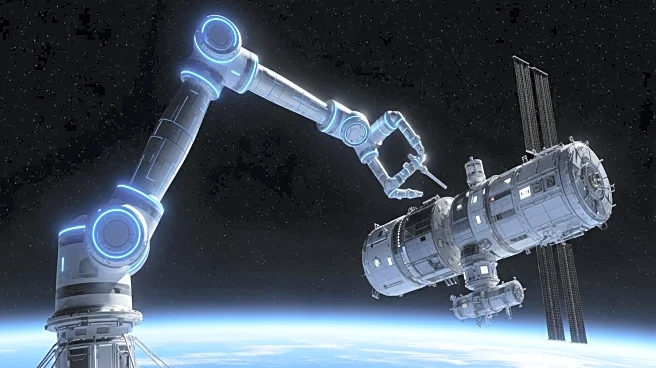
NASA is preparing to launch a robotic arm into orbit to assist in constructing vital infrastructure in space. This initiative is part of NASA's broader mission to support future space exploration, including plans to colonize the Moon. The robotic arm,
developed in collaboration with Motiv Space Systems, is designed to autonomously use tools and navigate across spacecraft in zero or partial gravity. This technology aims to facilitate robotic servicing, inspection, and assembly tasks in space. The mission, known as Fly Foundational Robots, is scheduled for late 2027 and is a precursor to NASA's Artemis II mission, which will send astronauts on a lunar mission in early 2026. SpaceX, led by Elon Musk, is among the businesses supporting NASA's efforts.
Why It's Important?
The deployment of the robotic arm represents a significant advancement in space technology, potentially revolutionizing how infrastructure is built and maintained in space. This development is crucial for establishing a sustainable human presence on the Moon and Mars, aligning with NASA's long-term goals. The technology could also have far-reaching implications on Earth, advancing industries such as construction, medicine, and transportation. By enhancing in-space operations, NASA aims to build a dominant space economy, which could lead to new opportunities for international cooperation and commercial ventures in space exploration.
What's Next?
NASA's upcoming Artemis II mission, set for February 2026, will involve a 10-day round trip to the Moon with astronauts Reid Wiseman, Victor Glover, Christina Koch, and Jeremy Hansen. Although the mission will not involve landing on the Moon, it will pave the way for Artemis III, which aims to achieve the first lunar landing since 1972. The success of these missions will be critical in demonstrating the viability of sustained human exploration and habitation on the Moon, potentially leading to further missions and technological advancements.
Beyond the Headlines
The introduction of autonomous robotic technology in space raises important ethical and operational considerations. As these technologies become more integrated into space missions, questions about the role of human oversight and the potential for autonomous decision-making in critical situations will need to be addressed. Additionally, the collaboration between NASA and private companies like SpaceX highlights the growing trend of public-private partnerships in space exploration, which could redefine the landscape of space policy and governance.