


What's Happening?
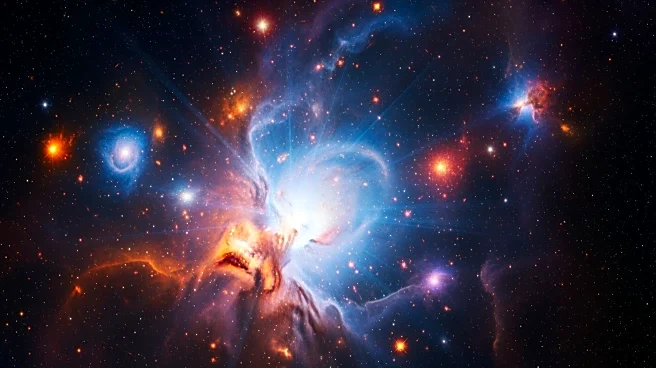
NASA's James Webb Space Telescope has captured detailed images of the Exposed Cranium Nebula, also known as Nebula PMR 1. This nebula, which resembles a brain, was first observed in infrared light by the Spitzer Space Telescope over a decade ago. The
Webb Telescope's advanced instruments, NIRCam and MIRI, have provided unprecedented detail, revealing distinct regions within the nebula that represent different phases of its evolution. The outer shell of the nebula consists mostly of hydrogen, while the inner cloud contains a mix of gases. The images show a dark lane running vertically through the nebula, suggesting an outburst from the central star.
Why It's Important?
The images captured by the Webb Telescope are significant as they provide insights into the life cycle of stars and the formation of nebulae. Understanding these processes is crucial for astronomers studying the evolution of the universe. The detailed observations of the Exposed Cranium Nebula can help scientists learn more about the end stages of a star's life and the conditions that lead to supernovae or the formation of white dwarfs. This knowledge contributes to our broader understanding of cosmic phenomena and the lifecycle of celestial bodies.
What's Next?
Scientists will continue to analyze the data from the Webb Telescope to gain a deeper understanding of the Exposed Cranium Nebula and similar cosmic structures. Further observations may reveal more about the mass of the central star and its potential fate. If the star is massive enough, it could end in a supernova, while a less massive star may become a white dwarf. Ongoing research will focus on these possibilities and the implications for our understanding of stellar evolution.