









What's Happening?
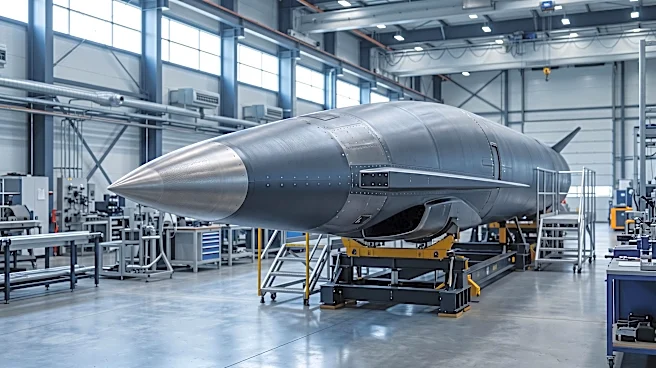
The U.S. Air Force has awarded Lockheed Martin a $694 million contract to begin production of its first hypersonic missile, the Air-Launched Rapid Response Weapon (ARRW). This decision marks a significant advancement for the long-sought capability, moving
ARRW from its testing phase directly into production. The Air Force announced this development on October 26, though specific details regarding the number of missiles ordered or their delivery timeline were withheld due to operational security concerns. This move signifies a critical step in modernizing the U.S. military's arsenal and enhancing its strategic capabilities. The ARRW program has been a key focus for the Air Force, aiming to provide a rapid-strike option with advanced maneuverability and speed, making it difficult for adversaries to detect and intercept.
Why It's Important?
The production of the ARRW hypersonic missile is a pivotal development for U.S. national security and global military dynamics. Hypersonic weapons, capable of traveling at speeds greater than Mach 5, offer a significant advantage by reducing reaction times for adversaries and increasing the effectiveness of strike operations. This capability enhances the U.S.'s ability to deter potential threats and respond swiftly to emerging crises. The investment in such advanced weaponry underscores a broader strategic shift towards maintaining a technological edge over competitors, particularly as other global powers also develop their own hypersonic programs. For the defense industry, this contract represents a substantial financial commitment and reinforces Lockheed Martin's role as a key innovator in advanced military technology. The successful deployment of ARRW could reshape military doctrines and strategic planning, influencing future defense budgets and international arms control discussions.
What's Next?
Following the production contract, the immediate next steps will involve Lockheed Martin scaling up manufacturing capabilities to meet the Air Force's requirements for the ARRW. While specific delivery timelines remain undisclosed, the focus will be on efficient production and integration into the U.S. Air Force's operational framework. Further testing and evaluation phases are likely to continue in parallel with production to ensure the weapon's reliability and effectiveness in various scenarios. The deployment of ARRW will likely prompt reactions from other major global powers, potentially accelerating their own hypersonic weapon development programs and leading to a new phase of strategic competition. The U.S. government will also need to consider the implications for international arms treaties and non-proliferation efforts as this new class of weapon becomes operational.
Beyond the Headlines
The introduction of hypersonic weapons like ARRW carries profound implications beyond immediate military capabilities. Ethically, the development of such advanced and potentially destabilizing weapons raises questions about the future of warfare and the potential for an arms race. The speed and maneuverability of hypersonic missiles could compress decision-making timelines in conflict situations, increasing the risk of miscalculation and unintended escalation. Legally, existing international arms control frameworks may struggle to adequately address the unique characteristics of hypersonic technology, necessitating new diplomatic efforts and agreements. Culturally, the pursuit of such advanced weaponry reflects a continuous drive for technological superiority in defense, influencing public perception of national security and military spending. The long-term shift could be towards a more complex and potentially volatile global security environment, where rapid technological advancements continually challenge traditional notions of deterrence and stability.