
What's Happening?
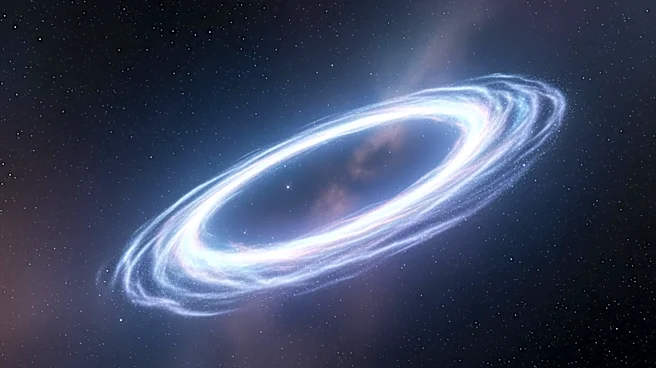
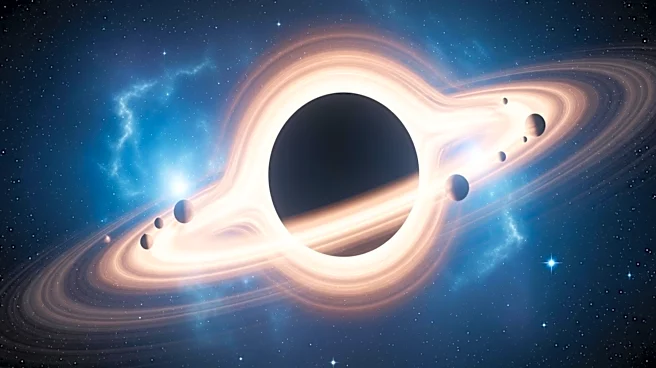
A new study suggests that the dusty regions surrounding active supermassive black holes could be fertile grounds for planet formation. Researchers have used computer modeling to argue that these environments
may host millions of planets, potentially forming the largest planetary populations in the universe. This challenges the traditional view of supermassive black holes as purely destructive forces. Instead, the study proposes that conditions in the outer disks of these black holes allow dust to gather and grow into planetary bodies. The research focuses on the outer edges of active galactic nuclei (AGN) disks, known as dust tori, which possess conditions similar to those found in planet-forming disks around young stars.
Why It's Important?
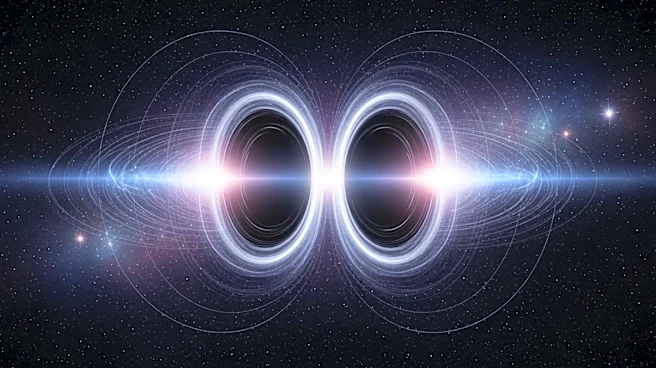
This discovery could significantly alter our understanding of planet formation and the role of black holes in the universe. If confirmed, it suggests that black holes are not just destructive but also creative forces, capable of generating new planetary systems. This could have implications for the search for extraterrestrial life, as it expands the potential habitats where life might exist. Additionally, understanding the mechanisms of planet formation around black holes could provide insights into the early stages of galaxy formation and evolution, offering a new perspective on the dynamics of the cosmos.
What's Next?
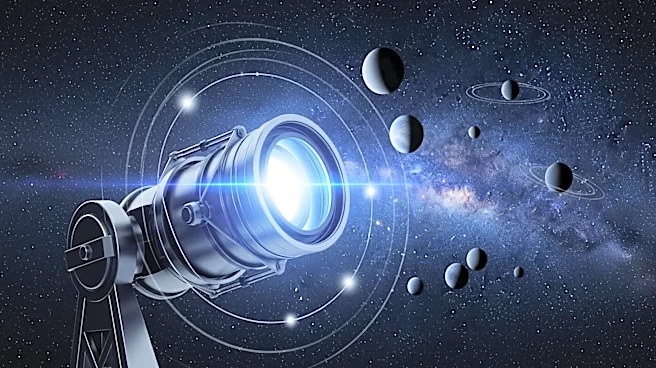
Further research and observations will be necessary to validate these findings. Astronomers may focus on identifying specific signatures of planet formation in the vicinity of supermassive black holes. This could involve using advanced telescopes and instruments to detect the presence of planets or protoplanetary disks in these extreme environments. The study opens new avenues for exploration in astrophysics, potentially leading to a deeper understanding of the universe's structure and the processes that govern it.