

What's Happening?
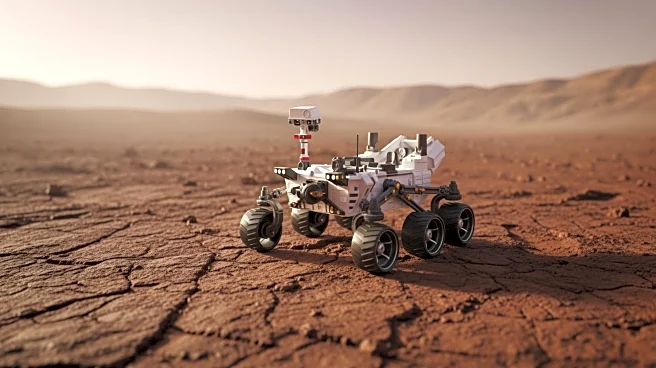
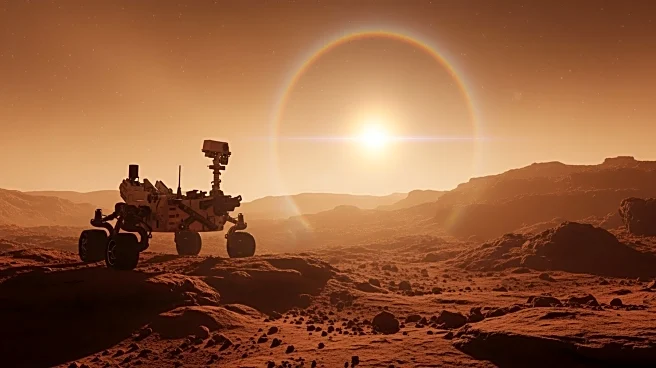
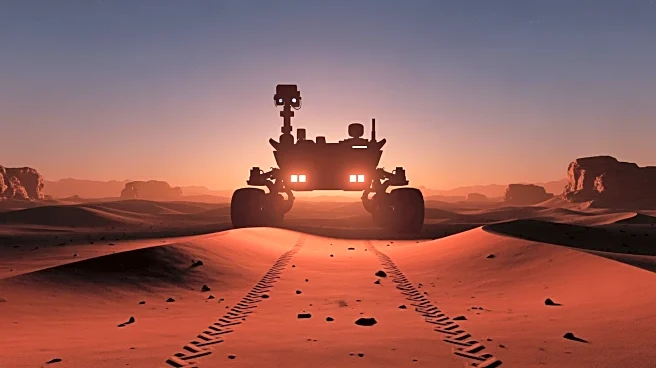
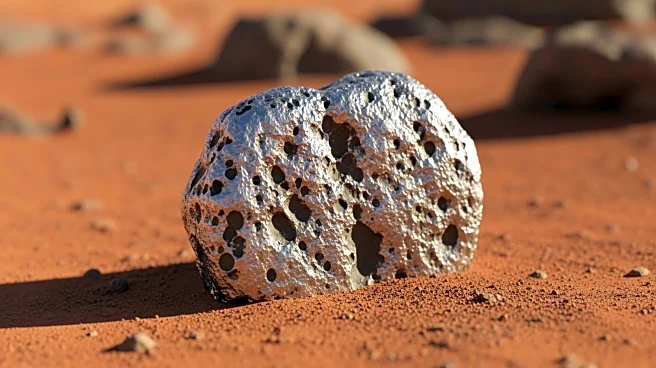
NASA's Perseverance rover has identified a rock on Mars, named Phippsaksla, which may be an iron-rich meteorite. Located in the Vernodden area near Jezero Crater, this desk-sized boulder stands out due to its sculpted shape and elevated position. Initial
analyses suggest that Phippsaksla contains iron and nickel, characteristics typical of iron-nickel meteorites. The discovery was led by Candice Bedford, a research scientist at Purdue University, who focuses on Martian geology. The rover, which has been exploring Jezero Crater for nearly five years, aims to collect rock and dust samples for future return to Earth. The presence of this potential meteorite highlights the ongoing surprises Mars holds, even in well-studied regions.
Why It's Important?
The discovery of Phippsaksla is significant as it could provide a sample of deep asteroid material without the need for a new mission. Meteorites like Phippsaksla, which contain iron and nickel, are remnants of early planetesimals and offer insights into the solar system's history. On Mars, such rocks can remain relatively unaltered due to the planet's thin atmosphere and dry surface. Understanding these meteorites helps scientists estimate the timeline of cosmic events and the history of impacts on Mars. Additionally, for future Mars missions, metal-rich meteorites could serve as resources for constructing tools or infrastructure, making them valuable for long-term human exploration.
What's Next?
The Perseverance team plans to conduct further observations to confirm Phippsaksla's composition and determine if it is indeed a meteorite. This will involve using the rover's instruments to analyze the rock's structure and chemistry more closely. If confirmed, Phippsaksla would provide a unique opportunity to study a piece of solar system history directly on Mars. The findings could refine models of impact chronology on Mars and inform future mission planning, including site selection for bases and sample depots. The ongoing investigation will continue to add to the understanding of Mars' geological history and its potential for supporting human exploration.
Beyond the Headlines
The potential discovery of a meteorite on Mars also raises questions about the planet's ability to preserve such rocks over long periods. The unique environmental conditions on Mars, such as its lack of liquid water and minimal atmospheric corrosion, allow for the preservation of metal-rich meteorites. This could provide a new perspective on space weathering processes and the long-term stability of extraterrestrial materials. Additionally, the study of Phippsaksla may offer insights into the distribution and frequency of meteorite impacts on Mars, contributing to a broader understanding of the planet's geological and environmental history.