







What's Happening?
The government of Bangladesh is finalizing an agricultural carbon credit framework aimed at reducing carbon emissions in farming and gaining financial benefits through carbon trading. The framework, prepared by the Ministry of Agriculture, is awaiting
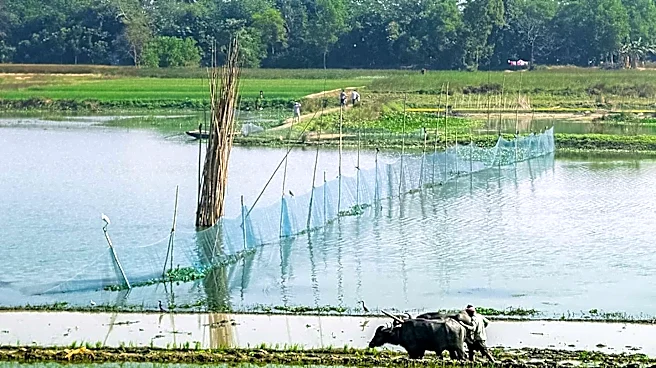
approval from the environment ministry. It focuses on sustainable agricultural practices, such as the alternate wetting and drying (AWD) method, which reduces water usage and methane emissions in rice cultivation. The framework aims to enable farmers to earn carbon credits by adopting climate-smart practices, which can be sold in carbon markets to provide additional income.
Why It's Important?
The development of a carbon credit framework is a significant step towards addressing climate change impacts in Bangladesh, a country highly vulnerable to environmental changes. By promoting sustainable farming practices, the framework can help reduce greenhouse gas emissions and improve water management. The financial incentives from carbon trading can enhance farmers' livelihoods and encourage the adoption of eco-friendly practices. This initiative positions Bangladesh to participate in global carbon markets, potentially attracting investment and fostering economic growth in the agricultural sector.
What's Next?
Once approved, the framework will be implemented to facilitate carbon trading in the agricultural sector. The government will likely provide training and support to farmers to adopt climate-smart practices. Monitoring and verification systems will be established to ensure the credibility of carbon credits. The success of this framework could lead to its expansion to other sectors, further integrating sustainability into Bangladesh's economic development. International collaboration and investment may also increase as Bangladesh demonstrates its commitment to reducing emissions and participating in global climate initiatives.