
What's Happening?
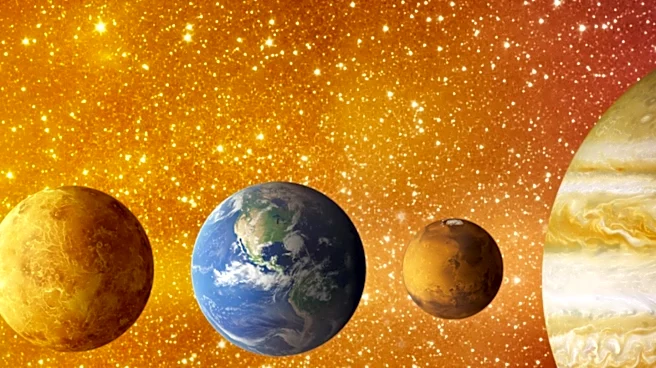
On November 25, 2026, a rare celestial event will occur before sunrise, featuring a close grouping of bright Jupiter, Mars, and the star Regulus. This alignment will be visible high in the southern sky,
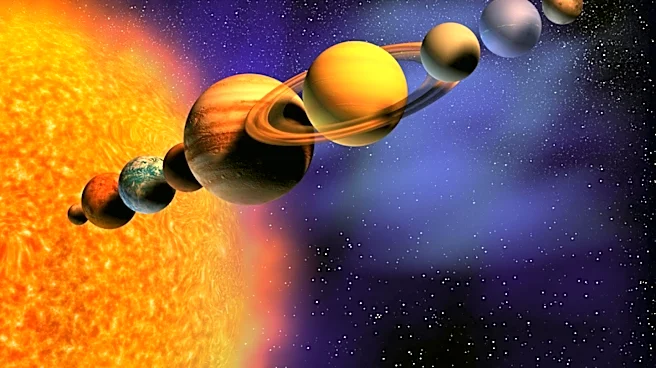
with Jupiter positioned 3.7 degrees from Regulus and Mars 3.6 degrees to Jupiter’s upper left and 1.7 degrees above Regulus. All three celestial bodies will fit within a single binocular field of view. This close grouping is particularly notable as a similar compact triangle of Jupiter, Mars, and Regulus will not occur again until September 28, 2062. Additionally, Uranus will be at opposition on the same night, making it visible through binoculars in the same field as the Pleiades star cluster, despite the bright Beaver Moon. Saturn will also be visible in the southeast after sunset.
Why It's Important?
This celestial event offers a unique opportunity for amateur astronomers and the general public across the U.S. to observe a rare planetary alignment. Such groupings provide a tangible connection to the mechanics of our solar system and the broader cosmos, fostering scientific curiosity and education. For educators, it serves as an excellent teaching moment about planetary motion, constellations, and observational astronomy. While not directly impacting U.S. industries or politics, these events contribute to the cultural and intellectual enrichment of society, inspiring future generations in STEM fields. The rarity of this particular alignment, not to be repeated until 2062, underscores its significance as a once-in-a-lifetime viewing experience for many.
What's Next?
Observers in the U.S. should plan to view the sky an hour before sunrise on November 25, 2026, looking towards the southern horizon to locate Jupiter, Mars, and Regulus. Binoculars will enhance the viewing experience, allowing all three to be seen together. For Uranus, observers should look for the Pleiades star cluster after sunset and use binoculars to locate the aquamarine planet near the bottom of the field, identifying specific stars in Taurus to aid in its location. Despite the bright moon, Uranus at opposition will be at its brightest and most visible. Local astronomical societies and observatories may host viewing events or provide additional guidance for optimal observation.
Beyond the Headlines
Beyond the immediate visual spectacle, such planetary alignments have historically held cultural and scientific significance, influencing early astronomy and navigation. While modern science provides precise predictions, the awe inspired by these cosmic dances remains. The mention of a triple conjunction for Mars, occurring three times during its appearance, highlights the intricate and predictable ballet of celestial mechanics. These events serve as a reminder of humanity's place in the vast universe and the enduring quest to understand the cosmos. The long interval until the next similar grouping in 2062 emphasizes the transient nature of these alignments, making the upcoming event a special moment for skygazers.