
What's Happening?
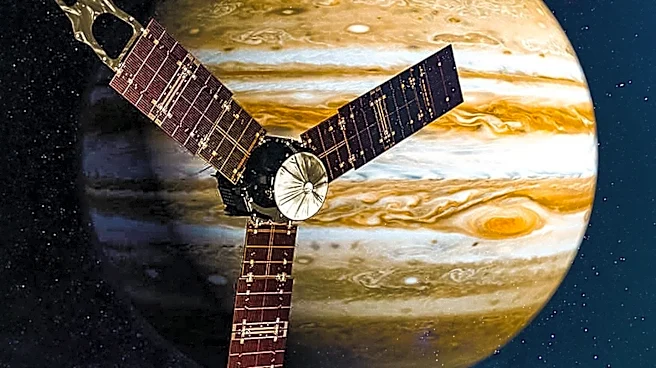
NASA's Juno spacecraft has conducted two close flybys of Jupiter's moon Io, utilizing its Microwave Radiometer (MWR) instrument to map the moon's heat patterns. The flybys, known as Perijove 57 and 58,
occurred on December 30, 2023, and February 3, 2024, respectively. These missions focused on Io's northern hemisphere and mid-latitudes, providing detailed data on the side of Io that constantly faces Jupiter. The Juno mission, managed by NASA's Jet Propulsion Laboratory, is part of NASA's New Frontiers Program. The spacecraft, built by Lockheed Martin Space, continues to operate and gather valuable data about Jupiter and its moons.
Why It's Important?
The data collected by Juno's MWR instrument is crucial for understanding the geological and volcanic activity on Io, which is the most volcanically active body in the solar system. By mapping the heat patterns, scientists can gain insights into the moon's internal structure and the processes driving its volcanic activity. This information not only enhances our understanding of Io but also contributes to broader knowledge about planetary formation and behavior in the solar system. The findings could have implications for future missions and the study of other celestial bodies with similar characteristics.
What's Next?
As Juno continues its mission, further flybys and data collection are expected to provide even more detailed insights into Io's geological activity. The ongoing analysis of the data will likely lead to new discoveries about the moon's volcanic processes and its interaction with Jupiter's magnetosphere. Future missions may build on Juno's findings to explore Io and other moons of Jupiter in greater detail, potentially paving the way for more advanced exploration and study of the Jovian system.