


What's Happening?
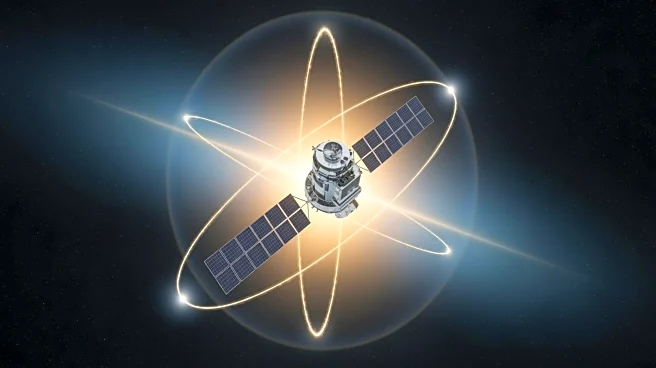
NASA's Interstellar Mapping and Acceleration Probe (IMAP) has successfully reached its destination at Lagrange point 1 (L1), approximately 1 million miles from Earth towards the Sun. The mission's operations team initiated trajectory maneuvers on January
9, 2026, and confirmed the spacecraft's entry into its final orbit at L1 on January 10. IMAP's mission is to explore and map the boundaries of the heliosphere, the protective bubble created by the solar wind that surrounds our solar system. The spacecraft will study the interaction between the heliosphere and the local galactic environment, focusing on the energization of charged particles from the Sun and the solar wind's interaction with interstellar space. IMAP's real-time observations will provide critical data to mitigate adverse space weather effects on spacecraft and humans. The mission, led by Principal Investigator David McComas from Princeton University, is part of NASA's Solar Terrestrial Probes Program.
Why It's Important?
The successful deployment of IMAP at L1 is significant for several reasons. It enhances our understanding of the heliosphere's role in protecting the solar system from cosmic radiation, which is crucial for future space exploration and the safety of astronauts. The data collected by IMAP will improve space weather forecasting, which is vital for the protection of satellites and other space-based technologies. Additionally, the mission supports scientific research into the fundamental processes of particle acceleration and solar wind interactions, contributing to the broader field of heliophysics. The mission's findings could have implications for understanding similar processes in other star systems, thereby expanding our knowledge of the universe.
What's Next?
IMAP is nearing the completion of its commissioning phase and is set to begin its science mission on February 1, 2026. The spacecraft will continue to provide real-time data on solar wind and energetic particles, enhancing the capabilities of existing missions like NASA's Wind, ACE, and ESA/NASA's SOHO. The mission's success could lead to further advancements in space weather prediction and heliophysics research, potentially influencing future space exploration strategies and technologies.