





What's Happening?
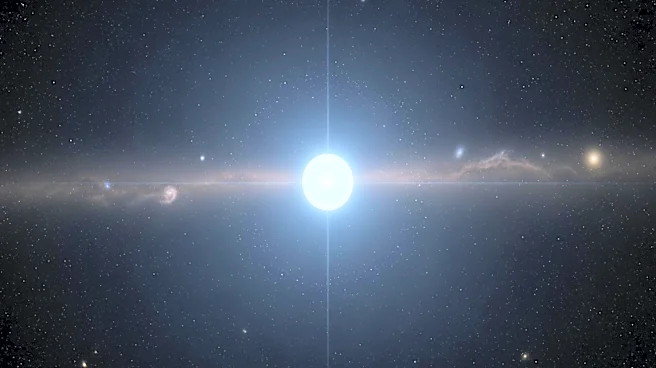
Astronomers have discovered SDSS J0715-7334, a star with remarkably low metallicity, indicating it is one of the most pristine ancient stars found. Located in the Milky Way, the star's composition is almost entirely hydrogen and helium, with minimal iron
and carbon. This suggests it formed from gas enriched by early supernovae. The star's position and motion imply it originated from the Large Magellanic Cloud, a dwarf galaxy orbiting the Milky Way. The discovery provides a window into the early Universe and the formation of the first stars.
Why It's Important?
The star's low metallicity offers valuable insights into the conditions of the early Universe and the formation of Population III stars, which were the first stars formed after the Big Bang. Understanding these stars helps astronomers piece together the history of star formation and the evolution of galaxies. The discovery also suggests that the Large Magellanic Cloud may contain more such stars, offering a new avenue for research into ancient stellar populations.
What's Next?
Further research will focus on identifying more ultra-metal-poor stars in different environments to test hypotheses about star formation in the early Universe. Astronomers will continue to study the Large Magellanic Cloud to uncover additional ancient stars and refine models of early star formation. The findings will contribute to a deeper understanding of cosmic evolution and the role of early stars in shaping the Universe.
Beyond the Headlines
The discovery highlights the importance of studying ancient stars to understand cosmic history. It also underscores the role of advanced telescopes and technology in uncovering hidden aspects of the Universe. The research may lead to new theories about the formation and evolution of galaxies, influencing future astronomical studies.