





What's Happening?
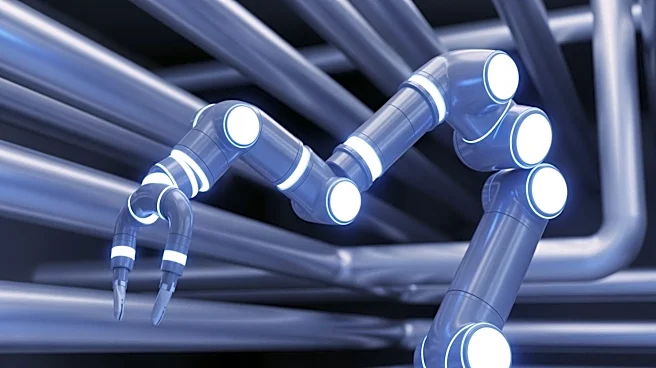
Researchers have developed a groundbreaking soft robot, known as SPPIRO, capable of navigating complex and branching pipeline networks. This fully untethered robot utilizes pneumatic origami actuators and proprioceptive sensing to maneuver through sharp
turns, T-junctions, and varying pipe widths. The SPPIRO system is designed to map the surrounding geometry in real-time, offering a significant advancement over conventional inspection machines. Traditional robots often struggle with the intricate internal geometry of pipelines, which can include sharp bends and varying diameters. SPPIRO's design, inspired by earthworm movement, allows it to adapt to these challenges effectively. The robot's central propulsion section features Kresling origami actuators that twist predictably, enabling precise navigation. Additionally, the robot's anchor modules can expand to brace against pipe walls, ensuring stability during inspection tasks.
Why It's Important?
The development of SPPIRO represents a significant leap forward in pipeline inspection technology. Pipelines are critical infrastructure for transporting oil, gas, and water, and undetected damage can lead to costly leaks and environmental harm. SPPIRO's ability to navigate complex pipeline networks autonomously reduces the need for human intervention, minimizing risk and improving inspection efficiency. This technology could revolutionize the maintenance of industrial pipelines, leading to more timely and accurate detection of potential issues. The robot's untethered design and real-time mapping capabilities make it suitable for a wide range of applications, from industrial inspections to environmental monitoring. By overcoming the limitations of traditional inspection robots, SPPIRO has the potential to enhance the safety and reliability of pipeline systems, benefiting industries and communities that rely on these networks.
What's Next?
Future developments for SPPIRO may include enhancements to its actuator designs and navigation systems. Researchers are exploring the integration of simultaneous localization and mapping (SLAM) technology to further improve the robot's autonomous capabilities. Addressing current limitations, such as friction during horizontal travel and contact singularities, will be key to optimizing SPPIRO's performance. As the technology matures, it could be deployed in real-world pipeline networks, providing valuable data for maintenance and safety assessments. Collaboration with industry partners could accelerate the adoption of SPPIRO in various sectors, leading to more efficient and cost-effective pipeline management.