







What's Happening?
China is making significant progress on its Tianwen 3 Mars sample-return mission, with a planned launch in 2028 and an anticipated Earth return in 2031. The mission aims to collect approximately 500 grams of Martian samples. According to the China National
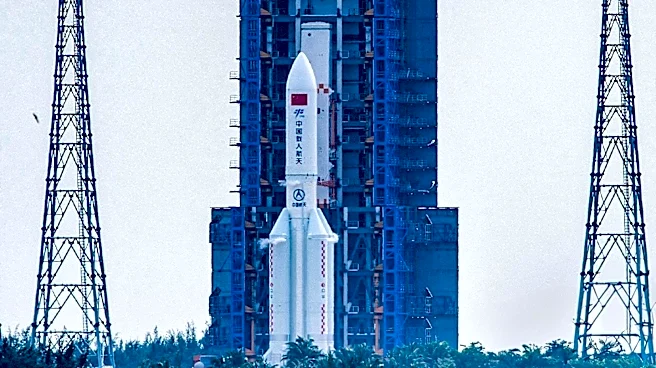
Space Administration, Tianwen 3 will comprise a lander, an ascender, a service capsule, an orbiter, and an Earth reentry module. The mission will utilize two Long March 5 heavy-lift rockets for its launch from the Wenchang Space Launch Site. Hou Zengqian, the mission's chief scientist, stated that the probe equipment has entered the prototype development phase, with numerous scientific teams collaborating on the mission's objectives. China is also in the process of selecting candidate landing sites, considering factors such as geological age, water activity history, habitability, and the potential for preserving biosignatures. A planetary protection laboratory is being established in Hefei to ensure the safe handling of returning Martian samples and to protect Earth's biosphere.
Why It's Important?
This mission represents a critical step in space exploration, potentially positioning China as a leader in the global race to bring Martian samples to Earth. The successful return of samples could provide unprecedented opportunities for scientific research into Mars's geology, environment, and the potential for past or present life. The mission's focus on searching for microbial traces and unknown life forms could yield groundbreaking discoveries, fundamentally altering our understanding of life beyond Earth. Furthermore, the establishment of a planetary protection laboratory underscores the international commitment to preventing biological contamination of Mars and safeguarding Earth from extraterrestrial life forms. If China succeeds in its 2031 return, it would mark a significant milestone, potentially influencing future international collaborations and competition in space exploration, especially given the current uncertainties surrounding NASA's own Mars sample return plans.
What's Next?
China expects to finalize the landing site for the Tianwen 3 mission by the end of 2026, with ongoing work on a next-generation geological map of Mars. The mission's launch window is set for December 2028 to January 2029. Following a successful launch, the mission will proceed with sample collection on the Martian surface and the complex process of returning them to Earth. The planetary protection laboratory will play a crucial role in the analysis of these samples, focusing on microscopic, molecular, and isotopic scales. The findings from these analyses will deepen our understanding of Mars's evolutionary history and habitability. The success of Tianwen 3 could accelerate future deep-space missions and potentially lead to new international standards for planetary protection and sample handling. The scientific community will closely monitor the mission's progress for insights into the origins of life and the potential for life beyond Earth.
Beyond the Headlines
The Tianwen 3 mission's ambitious goals extend beyond scientific discovery; it carries significant geopolitical implications. A successful Mars sample return by China could be seen as a 'Sputnik moment,' demonstrating advanced technological capabilities and potentially shifting the dynamics of global space leadership. This achievement could inspire increased investment in space programs worldwide and foster a new era of competition and collaboration. Ethically, the mission highlights the critical importance of planetary protection, ensuring that the pursuit of knowledge does not inadvertently harm either Mars or Earth. The rigorous protocols for sample handling and biological risk assessment reflect a growing awareness of our responsibility as cosmic explorers. The quest for evidence of life on Mars also challenges humanity's philosophical understanding of its unique place in the universe, potentially leading to profound societal and cultural shifts.