
What's Happening?
Recent research has highlighted the significant role of tree bark microbiota in the cycling of climate-active gases such as methane (CH4), hydrogen (H2), and carbon monoxide (CO). While trees are well-known
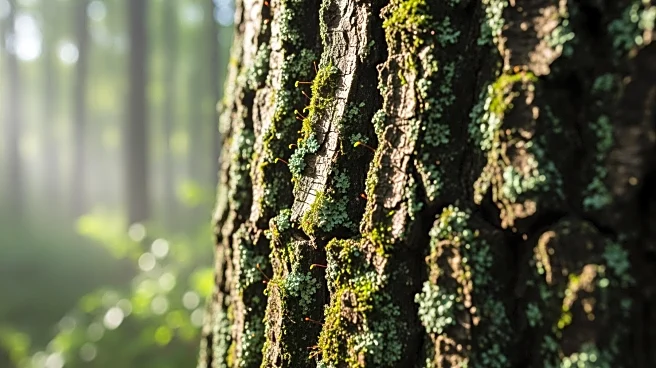
for their carbon sequestration capabilities through photosynthesis, their involvement in the modulation of other greenhouse gases has been less understood. The study, conducted by Leung, Jeffrey et al., reveals that the tree stem and bark, collectively known as the caulosphere, host a diverse microbial community that actively influences the fluxes of these gases. The research indicates that these microorganisms can consume these gases aerobically and produce them under anoxic conditions, suggesting a flexible metabolic adaptation to environmental changes. This discovery underscores the potential of tree bark microbiota to act both as a sink and a source of climate-active gases, depending on the environmental conditions.
Why It's Important?
Understanding the role of tree bark microbiota in gas cycling is crucial for comprehending the broader implications of forest ecosystems on global climate change. The ability of these microorganisms to modulate greenhouse gas fluxes could have significant impacts on atmospheric gas concentrations, influencing climate models and predictions. This research highlights the importance of considering microbial communities in climate change mitigation strategies, as they may offer new insights into natural processes that regulate atmospheric gases. The findings could lead to more accurate assessments of forest contributions to greenhouse gas emissions and sinks, potentially informing policy decisions and conservation efforts aimed at climate change mitigation.
What's Next?
Further research is needed to explore the specific mechanisms by which these microbial communities influence gas fluxes and to quantify their impact on a larger scale. Scientists may focus on different forest types and geographical regions to understand the variability and consistency of these processes. Additionally, the potential effects of climate change on these microbial communities and their gas cycling capabilities warrant investigation. Understanding how rising temperatures and changing environmental conditions affect these processes could provide valuable insights into future climate scenarios and help develop adaptive strategies for forest management and conservation.