





What's Happening?
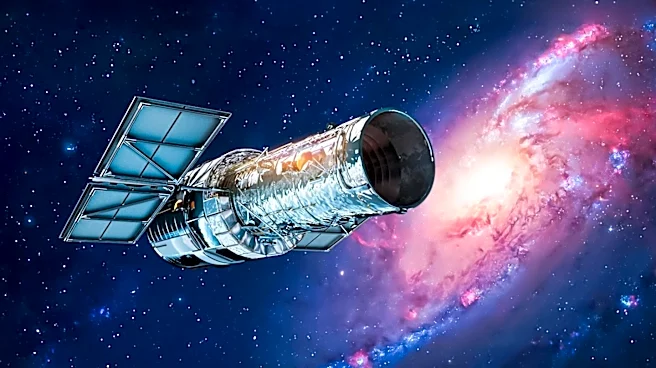
NASA’s Chandra X-ray Observatory has identified the cause of repeated outbursts from a giant, unstable star known as AT 2016blu, located in the spiral galaxy NGC 4559, approximately 30 million light-years from Earth. Astronomers discovered a previously
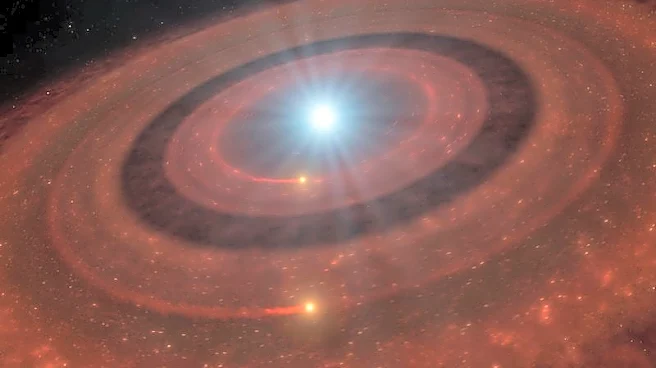
hidden companion object orbiting AT 2016blu, which pulls material away from the massive star every 113 days. This companion is either a stellar-mass black hole or a neutron star. This marks the first X-ray detection of this class of erupting stars and the first time such an object has been found with a black hole or neutron star companion. The star, a luminous blue variable, exhibits extreme brightness spikes resembling supernova explosions, yet it survives these events, earning it the moniker 'supernova impostor.'
Why It's Important?
This discovery is crucial for understanding the dynamics of binary star systems and the mechanisms behind extreme stellar variability. Identifying the companion object as a black hole or neutron star provides a clear explanation for the periodic outbursts, as material falling onto such compact objects heats up and emits intense X-rays, which then power the optical flashes. This finding also establishes a potential link between ultra-luminous X-ray sources (ULXs) and violent stellar eruptions, as AT 2016blu is bright enough in X-rays to be classified as a ULX candidate. Understanding these phenomena can shed light on the evolution of massive stars and the formation of compact objects, contributing to a broader understanding of stellar astrophysics.
What's Next?
Further observations with X-ray and optical telescopes will be necessary to precisely characterize the companion object and its orbital parameters. Scientists will aim to determine whether it is a black hole or a neutron star and to study the accretion process in more detail. This will involve continued monitoring of AT 2016blu's outbursts to refine models of mass transfer and energy release in such binary systems. The insights gained from this system could also guide searches for similar 'supernova impostors' and ULXs in other galaxies, potentially revealing more examples of massive stars interacting with compact companions. This research will contribute to a more complete picture of stellar evolution and high-energy astrophysical phenomena.
Beyond the Headlines
The discovery of a hidden compact companion driving a star's dramatic outbursts highlights the complex and often violent nature of stellar interactions in the universe. It underscores how much remains unknown about the life cycles of stars and the extreme environments they create. This research also exemplifies the power of advanced observatories like Chandra, which can peer into distant galaxies and uncover phenomena invisible to optical telescopes. The concept of a 'supernova impostor' is particularly intriguing, as it blurs the lines between different types of stellar explosions and challenges our classifications. This ongoing exploration of cosmic violence and transformation continually reshapes our understanding of the universe's fundamental processes.