









What's Happening?
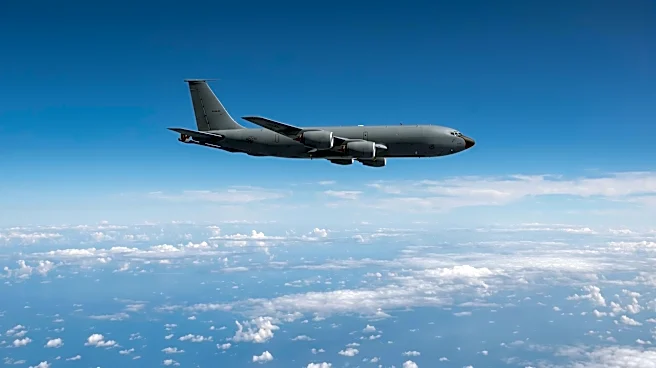
The U.S. Air Force is actively seeking to develop and deploy rapidly deployable drone swarms for enhanced base security and self-protection of Mobility Air Forces operating in contested airspace. This initiative aims to transform cargo planes into 'adaptive,
force-multiplying launch platforms' capable of deploying AI-controlled drone swarms. Once deployed, these swarms would autonomously defend Air Force bases and parked aircraft from attacks. The project, outlined in a Small Business Innovation Research (SBIR) solicitation, also envisions these drone swarms providing intelligence, surveillance, and reconnaissance capabilities for transport aircraft, effectively turning them into high-altitude drone motherships. The Air Force is looking for a single AI drone software to manage both aerial deployment and perimeter defense, emphasizing secure, encrypted military communications.
Why It's Important?
This development signifies a major leap in military defense strategy, moving towards autonomous and AI-driven security systems. The ability to rapidly deploy drone swarms from cargo planes could significantly enhance the protection of critical military assets and personnel in hostile environments, addressing vulnerabilities highlighted during conflicts like the Iran war where U.S. tankers and aircraft were damaged. This technology could reduce the need for human intervention in dangerous perimeter defense tasks, potentially saving lives and resources. Furthermore, integrating advanced ISR capabilities into transport aircraft would provide real-time situational awareness, improving operational effectiveness and decision-making. The emphasis on secure communications is crucial to prevent hacking and maintain command and control over these autonomous systems, which is vital for national security.
What's Next?
The Air Force's SBIR solicitation is moving directly to Phase II, indicating that the fundamental scientific and technical merit of coordinating multiple uncrewed aerial systems via AI has already been established by the private sector. This suggests a rapid progression towards practical implementation. Contractors will be tasked with demonstrating how cargo planes can deploy drone swarms at operational altitudes and how these swarms can autonomously monitor and defend designated perimeters. Beyond military applications, the SBIR also identifies potential 'dual-use' applications for these drone swarms, including domestic missions for the National Guard, such as disaster response, large-scale search-and-rescue operations, and persistent border surveillance. Commercial applications in areas like aviation monitoring are also being considered.
Beyond the Headlines
The pursuit of AI-controlled drone swarms raises profound ethical and strategic questions. The increasing autonomy of these systems necessitates robust discussions about accountability in the event of malfunctions or unintended consequences. The concept of 'industrial-level killing machines' (as mentioned in a related context) highlights the potential for a new era of warfare where human decision-making is increasingly delegated to algorithms. The dual-use potential of this technology, while offering benefits for civilian applications like disaster relief, also means that the proliferation of such advanced capabilities could pose challenges for international arms control and stability. The need for 'secure, encrypted military communications' underscores the growing cyber warfare dimension of modern conflict, where control over information and systems is as critical as physical dominance.