







What's Happening?
Sierra Pacific Industries (SPI), a fourth-generation family-owned company and one of the largest lumber and millwork producers in the U.S., is at the forefront of a controversy regarding its widespread use of herbicides in California forests. The company,
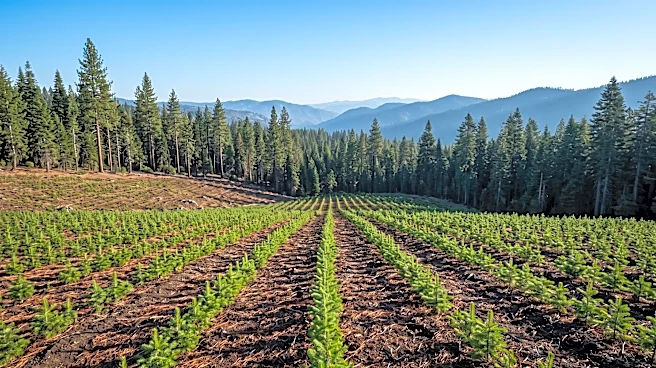
which owns and sustainably manages over 2.4 million acres of timberland across California, Oregon, and Washington, has filed 2,925 applications for pesticide use, making it the leading industrial forest company in this regard. This extensive application of herbicides, particularly glyphosate, is part of a broader strategy by forest managers, including the U.S. Forest Service, to reduce shrubs that compete with planted seedlings for future timber harvests and to mitigate wildfire risks. However, this practice has drawn significant opposition from neighboring landowners and Plumas County residents, who express concerns about public health and environmental impacts. The Plumas Grassroots Collective has mapped 4,448 pesticide applications totaling 430,000 pounds of pesticides from 2020 to July 2026, with SPI accounting for a substantial portion.
Why It's Important?
The extensive use of herbicides by major timber companies like Sierra Pacific Industries has significant implications for environmental health, public policy, and community well-being in the U.S. The debate highlights a critical dilemma for forest managers: balancing the need for forest regeneration and wildfire prevention with concerns over chemical exposure. Opponents, including the Plumas Grassroots Collective, argue that chemicals like glyphosate, classified in California as a known carcinogen, pose risks to human health, particularly for communities living near treated areas and those relying on local water sources. This situation could lead to increased regulatory scrutiny on herbicide use in forestry, potentially influencing future land management practices and environmental protection policies. The controversy also underscores the tension between industrial forestry practices aimed at maximizing timber production and community demands for ecological preservation and public health safety. The outcome of this debate could set precedents for how private and public forest lands are managed across the nation, affecting both the timber industry and environmental advocacy groups.
What's Next?
The ongoing controversy surrounding Sierra Pacific Industries' herbicide use is likely to intensify, with continued advocacy from groups like the Plumas Grassroots Collective. These groups plan to expand their mapping efforts to include pesticide information for every California county and offer independent water quality testing for pesticides, which could reveal further evidence of chemical presence in local environments. Legal challenges, such as the 2024 lawsuit against the Forest Service alleging that the Plumas Community Protection project prioritizes timber extraction over community protection, are still pending and could influence future land management decisions. Additionally, community activists are exploring and promoting alternative methods for vegetation management, such as using goats for grazing, to demonstrate viable non-chemical solutions. The public and regulatory bodies will likely continue to pressure forest managers, including SPI and the U.S. Forest Service, to re-evaluate their herbicide application strategies, potentially leading to policy changes or increased restrictions on chemical use in forest ecosystems.
Beyond the Headlines
Beyond the immediate concerns of chemical exposure and forest management, this situation touches upon deeper ethical and cultural dimensions regarding humanity's relationship with natural landscapes. The reliance on herbicides reflects a technocentric approach to environmental challenges, prioritizing efficiency and economic output in timber production and fire suppression. However, this approach often clashes with community values that emphasize ecological integrity, public health, and traditional land stewardship. The debate also highlights the long-term consequences of historical forest management practices, such as a century of fire suppression and industrial logging, which have contributed to the current dilemma of increased wildfire risk and the potential conversion of conifer forests to chaparral. This conflict prompts a re-evaluation of sustainable forestry models, encouraging a shift towards more holistic and community-inclusive strategies that consider the interconnectedness of ecosystems and human well-being. The outcome could influence a broader societal discussion on how to balance economic interests with environmental protection and public health in the face of climate change and increasing natural disasters.