







What's Happening?
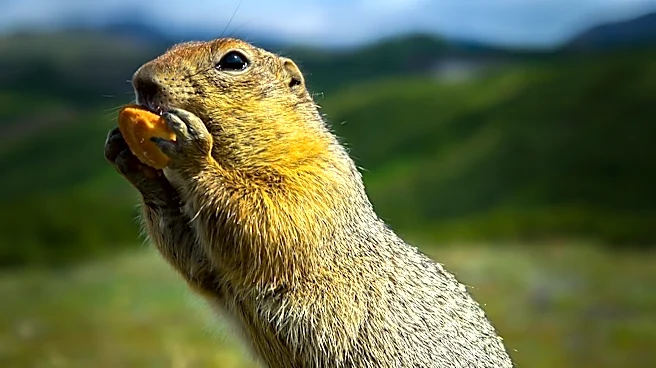
Research on thirteen-lined ground squirrels is offering new perspectives on retinal development and photoreceptor differentiation. Unlike most mammals, these squirrels have a higher ratio of cones to rods in their retinas, a trait that deviates from the typical
mammalian pattern shaped by evolutionary pressures during the Mesozoic Era. Seth Blackshaw, a neuroscience professor at Johns Hopkins University, is investigating the genetic and developmental mechanisms that lead to this unique retinal structure. His work aims to understand how increased cone production occurs and how retinal cells differentiate, providing insights into the evolution of vision in mammals.
Why It's Important?
The study of ground squirrels' retinal development could have broader implications for understanding vision and eye health in humans. By exploring the genetic factors that influence photoreceptor differentiation, researchers can gain insights into conditions that affect vision, such as color blindness and retinal degeneration. This research also contributes to the broader understanding of how evolutionary pressures shape sensory systems, offering potential applications in developing therapies for visual impairments.
What's Next?
Future research will focus on further elucidating the genetic pathways involved in retinal development and exploring how these findings can be applied to other species, including humans. The challenges of working with seasonal breeders like ground squirrels highlight the need for innovative approaches to studying retinal biology. Continued collaboration with breeding programs and advancements in genetic analysis techniques will be crucial for advancing this field of study.