



What's Happening?
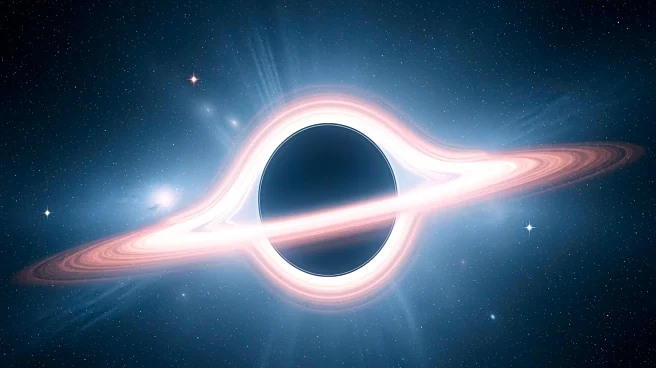
In 2025, astronomers using the James Webb Space Telescope (JWST) discovered a supermassive black hole in the galaxy CANUCS-LRD-z8.6, which existed just 570 million years after the Big Bang. This black hole, with a mass equivalent to 36 billion suns, is located
in one of the most massive galaxies ever observed, 5 billion light-years from Earth. The discovery challenges current understanding of black hole and galaxy formation in the early universe, as it suggests that such massive black holes could form much earlier than previously thought. The JWST has been instrumental in identifying these 'little red dot' galaxies, which are small, bright, and extremely distant objects.
Why It's Important?
The discovery of this supermassive black hole has significant implications for our understanding of the early universe. It challenges existing models of black hole and galaxy formation, suggesting that these processes may occur more rapidly than previously believed. This could lead to a reevaluation of the timeline and mechanisms of cosmic evolution. The findings also highlight the capabilities of the JWST in exploring the distant universe, providing insights into the conditions and structures that existed shortly after the Big Bang. This research could pave the way for new theories about the formation and growth of black holes and galaxies.
What's Next?
Future research will likely focus on understanding the mechanisms that allowed such a massive black hole to form so early in the universe's history. Scientists may conduct further observations using the JWST and other telescopes to identify similar objects and gather more data on their properties. This could involve studying the surrounding environment of these black holes to determine the factors that contributed to their rapid growth. Additionally, theoretical models may be revised to incorporate these new findings, potentially leading to a more comprehensive understanding of the early universe.