
What's Happening?
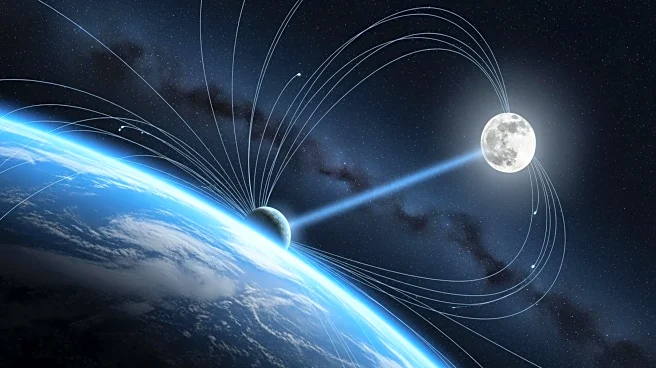
A new study by astrophysicists at the University of Rochester has found that Earth's magnetic field is funneling particles from the atmosphere onto the Moon's surface. This process, which has been ongoing
for billions of years, contributes to the abundance of volatile elements found in the lunar regolith. The study challenges previous assumptions that Earth's atmosphere could only have influenced the Moon before the development of the planet's magnetic field. By simulating different scenarios, researchers discovered that the modern Earth model, with a strong magnetic field, better explains the presence of these particles on the Moon. The solar wind plays a crucial role by knocking charged particles out of the atmosphere and directing them along Earth's magnetic field lines to the Moon.
Why It's Important?
This discovery provides a new perspective on the interaction between Earth and the Moon, offering insights into the historical changes in Earth's atmosphere. The presence of volatile elements on the Moon serves as a time capsule, preserving data about Earth's atmospheric evolution. Understanding this process could have implications for future lunar exploration and the study of planetary atmospheres. The findings also suggest that similar mechanisms might be responsible for delivering oxygen to the Moon, potentially creating water and rust. This research could influence future missions aimed at studying the Moon's surface and its potential resources.
What's Next?
The study opens up new avenues for research into the long-term effects of Earth's atmospheric particles on the Moon. Future investigations could focus on the implications of these findings for lunar exploration and the potential for utilizing lunar resources. As scientists continue to explore the Moon's surface, they may uncover more about the historical interactions between Earth and the Moon, providing valuable data for understanding planetary processes. This research could also inform the development of technologies for future lunar missions, particularly those aimed at resource extraction and habitat construction.