





What's Happening?
Researchers at Cornell University have developed a new laser-cooling technique that significantly speeds up the cooling process for quantum computers. This innovation, led by Karan Mehta, assistant professor of electrical and computer engineering, was
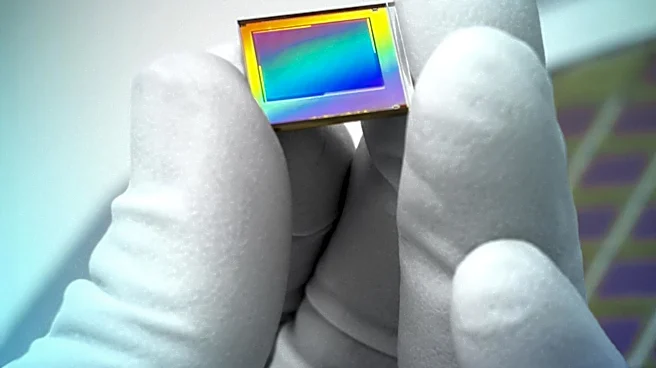
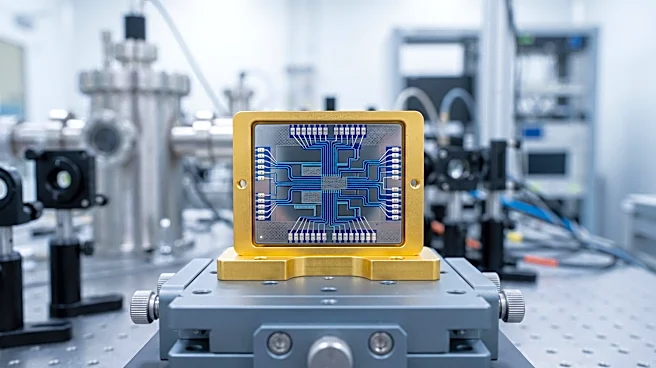
published in the journal PRX Quantum. The technique involves integrating optical components directly into a microfabricated chip, which delivers precisely controlled laser light, known as a standing wave, to trapped atoms. By positioning a trapped calcium ion at a point of minimum light intensity within this standing wave, energy is removed from its motion, suppressing unwanted heating. This method brings the ion's targeted motion close to its quantum ground state in approximately 150 microseconds, a substantial improvement compared to the 500 microseconds typically required by conventional laser arrangements. The integrated chip design allows for the delivery of multiple wavelengths of light needed to control the ion, a crucial step towards scaling up quantum computing systems. The chips were commercially fabricated in the Netherlands through a collaboration with ETH Zurich, with Cornell facilities used for packaging and experimental preparation.
Why It's Important?
This advancement is critical for the progression of quantum computing, as cooling operations currently represent a major bottleneck in the operating time of leading quantum systems. Quantum computers rely on individual electrically charged atoms (ions) suspended in electromagnetic fields to process information. Even minimal unwanted movement in these ions can disrupt calculations, necessitating repeated cooling to near their lowest possible energy states. By reducing the cooling time by more than half, this new technique can significantly enhance the efficiency and speed of quantum computations. The ability to simultaneously cool all three measured modes of an ion's motion, spanning a frequency range of approximately 5 megahertz, is also a key breakthrough. Conventional methods often require separate cooling operations for different types of motion, making this integrated approach more efficient and scalable. This development could accelerate the transition from experimental quantum computing to more practical and larger-scale applications, potentially impacting fields that require immense computational power.
What's Next?
The immediate next steps involve further research and development to apply this technique to larger trapped-ion quantum computers. While the current experiments focused on a single ion, the approach is designed to be scalable for systems with many more qubits. The integration of optical components into a chip is a foundational step that other research groups are also pursuing to extend quantum systems. This faster and more efficient cooling mechanism could pave the way for quantum computers to perform practical calculations that require hundreds or thousands of qubits, a scale not yet achievable. The broader significance, as noted by Mehta, is that this work demonstrates how technologies aimed at making quantum computers larger can simultaneously improve their fundamental operations. Continued collaboration with commercial fabricators and research institutions will be essential to refine and implement this technology in future quantum computing architectures.
Beyond the Headlines
The development of chip-based laser cooling touches upon several deeper implications for the future of technology. Ethically, faster quantum computing could accelerate breakthroughs in medicine, materials science, and artificial intelligence, but also raise questions about data security and the potential for new forms of surveillance or warfare. Legally, the intellectual property surrounding such advanced quantum technologies will become increasingly valuable and contested, potentially leading to patent disputes as the field matures. Culturally, the realization of powerful quantum computers could fundamentally alter our understanding of computational limits and human capabilities, similar to the impact of classical computers. This innovation also highlights a long-term shift towards miniaturization and integration in complex scientific instruments, moving away from bulky, external setups to compact, chip-scale solutions. The ability to cool ions more efficiently could also reduce the energy footprint of quantum computers, addressing environmental concerns associated with high-performance computing.