


What's Happening?
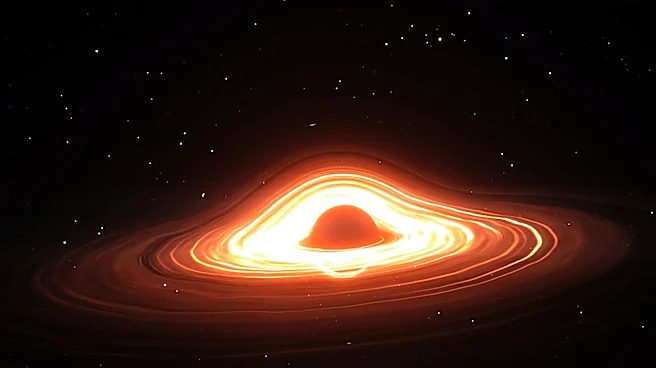
Astronomers have discovered a new record-breaking star, S301, which is the closest known star to the Milky Way's supermassive black hole, Sagittarius A*. Reported on August 19 in Nature, S301 reaches speeds of 25,000 kilometers per second, approximately
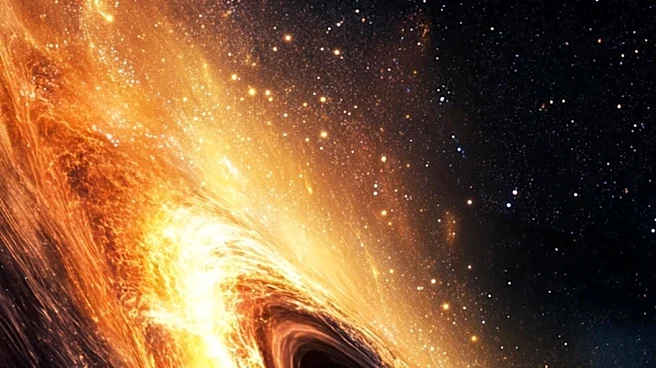
8% the speed of light. Its extreme proximity to Sagittarius A* makes it a unique tool for measuring the black hole's elusive characteristic: spin. Stefan Gillessen, an astronomer at the Max Planck Institute for Extraterrestrial Physics, highlighted the star's potential for understanding black hole physics. S301, about 50% larger than the sun, was first observed in 2023 by the GRAVITY+ collaboration using the European Southern Observatory’s Very Large Telescope Interferometer. By combining two subsequent years of observations with historical data dating back to 2017, astronomers mapped its 8.7-year, highly elongated orbit, which brings it within 1.7 billion kilometers of Sagittarius A*. This close orbit is crucial because the black hole's spin is expected to subtly alter the star's trajectory over time, providing direct data for calculating the spin.
Why It's Important?
The discovery and study of star S301 are profoundly important for astrophysics and our understanding of the universe. Measuring the spin of Sagittarius A* directly, using S301's orbit, offers a novel and more direct method compared to previous indirect measurements that relied on X-ray emissions or gravitational waves. This direct measurement can provide crucial insights into how supermassive black holes grow and evolve. A fast spin suggests a black hole has consistently accreted matter, while a slower spin indicates a more chaotic feeding history. Understanding black hole spin also helps explain their influence on surrounding galaxies, including the generation of powerful jets and winds. Furthermore, a precise measurement of Sagittarius A*'s spin will serve as a critical test for Einstein's theory of general relativity. Any deviation from the theory's predictions regarding black hole spin could challenge our fundamental understanding of gravity and the cosmos. This research pushes the boundaries of observational astronomy, utilizing advanced instrumentation to probe extreme astrophysical phenomena and refine theoretical models.
What's Next?
Astronomers plan to continue tracking S301's orbit over the next 15 years or so. By meticulously observing the subtle changes in its trajectory caused by Sagittarius A*'s spin, they will gather enough data to precisely calculate the black hole's spin. This long-term observational campaign will be critical for validating the theoretical predictions of general relativity and providing a direct measurement of a supermassive black hole's spin. The GRAVITY+ collaboration will likely continue to utilize the European Southern Observatory’s Very Large Telescope Interferometer for these observations. The data collected will not only refine our understanding of Sagittarius A* but also contribute to a broader comprehension of black hole dynamics across the universe. Future research may also involve searching for other stars in similarly close orbits to supermassive black holes, which could offer additional opportunities for direct spin measurements and further tests of gravitational theories. The scientific community eagerly awaits the results of these ongoing observations, which promise to unlock new secrets of cosmic evolution.
Beyond the Headlines
The study of star S301 and its interaction with Sagittarius A* delves into the fundamental nature of space, time, and gravity, pushing the boundaries of human knowledge. The concept of a black hole's spin, while seemingly abstract, has profound implications for understanding the most extreme environments in the universe. It connects to the very fabric of spacetime, as predicted by Einstein's general relativity, where massive rotating objects can 'drag' spacetime around them. The ability to directly measure this effect through the orbit of a star like S301 is a testament to the ingenuity of modern astronomy and engineering. This research also highlights the collaborative nature of scientific discovery, involving international teams and advanced observatories. Beyond the scientific implications, such discoveries inspire a sense of wonder and curiosity about our place in the cosmos, reminding us of the vastness and complexity of the universe. It underscores the ongoing quest to unravel the mysteries of black holes, which remain some of the most enigmatic objects in existence, challenging our intuition and expanding our understanding of physical laws.