



What's Happening?
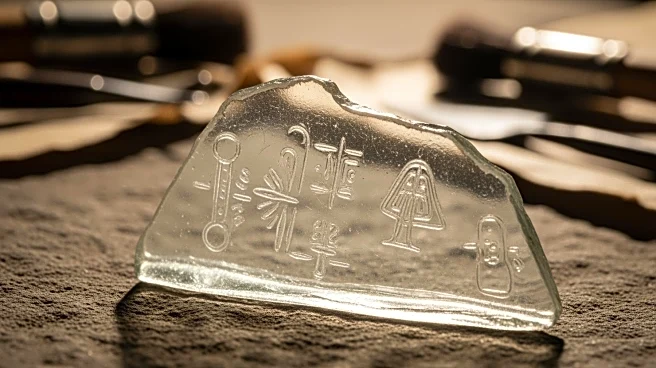
Hallie Meredith, an art history professor and glassblower at Washington State University, has discovered previously overlooked symbols on ancient Roman glass cage cups. These symbols, found on luxury vessels carved between 300 and 500 CE, were traditionally
seen as decorative. Meredith's research suggests they are makers' marks, identifying the workshops and artisans responsible for these complex glass objects. Her findings, published in academic journals, indicate that Roman glass production involved coordinated teams of engravers, polishers, and apprentices, rather than individual artisans. This discovery sheds light on the collaborative nature of ancient Roman glassmaking and the social history of craft labor.
Why It's Important?
Meredith's findings challenge long-held assumptions about Roman glass production, emphasizing the importance of understanding the people behind ancient artifacts. By identifying makers' marks, her research highlights the collaborative efforts of Roman artisans, offering a new perspective on ancient craft labor. This insight not only enriches the historical understanding of Roman glassmaking but also underscores the value of interdisciplinary approaches in archaeology and art history. The study of these symbols as a form of ancient branding provides a deeper appreciation of the social and economic networks that supported Roman artisans.
What's Next?
Meredith plans to expand her research by creating a searchable database of unconventional writings on ancient artifacts, collaborating with computer science students. This project aims to explore multilingual artisans' adaptations of written language for diverse audiences. Additionally, her forthcoming book, 'The Roman Craftworkers of Late Antiquity,' will further explore the social history of glass production. These efforts will continue to illuminate the lives and contributions of ancient craftworkers, potentially reshaping the understanding of ancient economies and societies.
Beyond the Headlines
Meredith's work emphasizes the importance of empathy in historical research, encouraging scholars to consider the human aspects of ancient production processes. By integrating practical glassblowing experience with academic research, she offers a unique perspective on the physical demands and collaborative nature of ancient craftsmanship. This approach not only enhances the study of Roman artifacts but also fosters a broader appreciation for the labor and creativity of ancient artisans, challenging the traditional focus on elite figures in historical narratives.